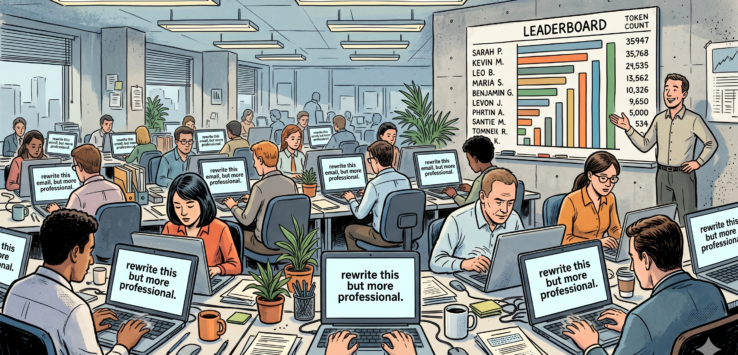
“I asked it to rewrite the same email forty-seven times,” said Brandon, with the specific pride of a man describing a personal record. “Different tones, different lengths, different reading levels. I sent version one. But the token count was beautiful.”
Nobody at the table said anything for a moment.
“You spent company compute writing forty-six emails you didn’t send,” said Mr. X.
“I spent company compute demonstrating AI fluency.“
“Those are different things.”
“In a performance review,” Brandon said, “they are the same thing.”
He had a point, which was the depressing part. Brandon is a senior product manager at a large tech company whose name you would recognize, and he had spent the better part of the last quarter doing what the industry had recently named tokenmaxxing — the practice of running as many prompts through company AI tools as possible, not because the output was useful, but because someone had decided that token spend was a proxy for AI adoption, and AI adoption was a proxy for not being the person who got laid off next.
We were at a wine bar in the Mission — myself, Mr. X, Brandon, and Claudia, an engineering manager at a different large tech company who had the specific exhaustion of someone who had just spent two weeks trying to explain to her leadership why the dashboard her team built to track AI token spend had gone viral on tech Twitter and then been quietly taken down.
“Walk me through the dashboard,” I said.
Claudia looked at her wine. “One of our engineers built it. Internally. To track token usage across teams. We had sixty trillion tokens in a month.”
“Sixty trillion.”
“Sixty trillion. Which sounds like a lot until you realize a significant percentage of it was people asking the AI to summarize things they already knew, reformat documents they were going to throw away, and generate code they weren’t going to run — specifically because the usage dashboard was visible to managers.”
“So the metric created the behavior it was measuring,” said Mr. X.
“Beautifully put. Yes.”
“The metric,” said Brandon, slightly defensively, “also reflected genuine adoption.”
“Did it?” Claudia asked. “Because when I audited the top ten token spenders on my team, seven of them had the lowest actual output by every other measure. They were tokenmaxxing. The people actually getting things done were using AI efficiently — which means fewer tokens, not more.”
Brandon had the look of a man who had been quietly accused of something he had also privately suspected about himself. “Efficiency isn’t the only signal—”
“What’s the other signal?”
“Exploration. Experimentation. Learning the capabilities of the tools.”
“You sent the same email forty-seven times,” said Mr. X.
“I was exploring tone.”
A silence descended that was both comfortable and pointed.
“Here’s what I find genuinely fascinating about this,” I said. “The entire premise of AI in the workplace — the pitch that justified every rollout, every mandate, every return-to-office policy framed around collaboration with the tools — was that AI would handle the tedious work so humans could focus on higher-value thinking.” I looked at Brandon. “And what we’ve produced is a class of workers whose primary cognitive task is figuring out how to make it look like they’re using AI productively, rather than actually using it productively.”
“Cargo cult productivity,” said Claudia.
“Is that a term?”
“It is now.”
“The thing that keeps me up at night,” she continued — and she said it with the tone of a person for whom it was genuinely keeping her up — “is that we’ve tied employment security to a metric that can be gamed in forty-five minutes by anyone moderately clever. Which means the performance reviews are now measuring cleverness about gaming the metric, not actual work.” She paused. “Meanwhile the people doing the actual work are producing fewer tokens and wondering why their ratings are lower.”
Brandon was quiet for a moment. Something honest was happening behind his eyes. “I know it’s absurd,” he said finally. “I know. But what am I supposed to do? My manager’s manager gave a talk about AI adoption at the all-hands. There was a slide with everyone’s token counts on it. My name was in the bottom half.” He picked up his drink. “I have a mortgage.”
Nobody said anything to this, because it was the most reasonable thing anyone had said all evening.
“The mortgage is doing a lot of work in that sentence,” Mr. X said gently.
“It’s doing all the work,” Brandon said. “Which is maybe the point.”
Outside a Waymo turned the corner and for a moment I thought about all the humans who had generated all the tokens to train the models that were now being used to evaluate whether the humans were using the models enough to justify keeping the humans, and then I stopped thinking about it because the recursive loop had nowhere comfortable to go.
“You know what the tell is?” Claudia said, on the way out. “Meta built the dashboard. Tracked sixty trillion tokens. Then someone leaked it, it went viral, the story wrote itself — employees game AI metrics to avoid layoffs — and they took the dashboard down.” She buttoned her jacket. “They didn’t fix the problem. They removed the evidence.”
“That’s very efficient,” said Mr. X.
“One token at a time,” she said.
Outside the fog was coming in the way it does, indifferent and democratic, covering the Mission and the Marina and the data centers in the South Bay with equal thoroughness. Somewhere a server was running warm generating output nobody would read. Somewhere a manager was looking at a token dashboard feeling good about adoption curves.
Brandon checked his phone on the way to his car. He had three AI tasks queued up for the morning.
“Exploring tone?” I asked.
“Demonstrating fluency,” he said, without irony, and meant it only about seventy percent.