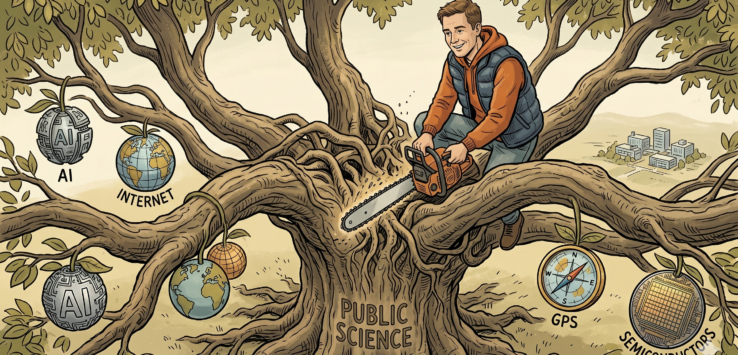
Peter Thiel went to Stanford. Marc Andreessen did not, but his money goes there, or at least it did until his money started going toward the people dismantling it. These are the kinds of details that feel like they should be contradictions but have somehow, in 2026, become a coherent philosophy.
The conversation started the way the best ones do — with someone saying something that sounded reasonable until you thought about it for thirty seconds.
“Basic research is inefficient,” said Connor, a venture partner at a fund whose website described its thesis as “backing founders who move at the speed of reality.” He said it with the calm certainty of a man who had arrived at a conclusion through a process that did not involve reading much history. “The NIH budget funds ten thousand projects and maybe one of them produces something commercially meaningful in twenty years. That’s not a good return profile.”
“It’s not supposed to have a return profile,” said Dr. Yemi, a computational biologist who had spent twelve years at a public university research lab before her grant got cut and she pivoted, with visible reluctance, to a biotech startup. “That’s the entire point.”
We were at dinner in Palo Alto — myself, Mr. X, Connor, and Dr. Yemi, who had been introduced to the group through a mutual contact and who had arrived with the specific energy of someone attending an event they expect to find frustrating but feel professionally obligated to attend anyway.
“Basic research is how you find the things you didn’t know you were looking for,” she continued. “You don’t get GPS without federal investment in atomic clocks. You don’t get the internet without DARPA. You don’t get the touchscreen on your phone without government-funded materials research. You certainly don’t get the transformer architecture behind every large language model without decades of publicly funded academic work.” She looked at Connor. “You are, professionally speaking, living off an inheritance you’re currently voting to spend.”
Connor smiled the smile of a man who had heard versions of this argument and had developed an immunity to it. “Look, I’m not saying basic research has no value. I’m saying the delivery mechanism is broken. Bureaucratic. Slow. The private sector can fund early-stage science more efficiently—”
“Show me the private sector funding for research that won’t have a commercial application for thirty years,” said Mr. X.
“That’s what we’re changing. The timeline is compressing—”
“You’re not compressing the timeline for basic science. You’re skipping it and hoping the foundations hold.” Mr. X poured more wine with the unhurried energy of a man making a point through contrast. “Which is a reasonable bet if you’re planning to exit in five years.”
Connor looked like he wanted to push back on this and couldn’t quite find the angle. “The argument that we should keep funding a system because it produced good things decades ago is—”
“Working at a seed stage company,” I said. “Literally. The semiconductor. The internet. The smartphone. The AI revolution. All of it.” I looked at him. “The tree doesn’t stop needing roots because the fruit tastes good.”
Dr. Yemi had set down her fork, which with her was a sign that she had moved from making a point to making an accounting. “Do you want to know what actually happened to my lab? Fourteen researchers. We were working on protein folding mechanisms — the kind of basic structural biology that, a decade from now, might have implications for drug development, might have implications for biomaterials, might have implications for things nobody has thought of yet. Might.” She said the word carefully. “The grant didn’t get renewed. Three of my colleagues took industry jobs. Two left science entirely. Two are doing AI data labeling, which is what we apparently do with scientists now. The equipment sat idle for four months before we figured out how to transfer it.”
“Some of that talent ended up in startups, though,” Connor said, not cruelly, just accurately.
“Some of it,” she said. “The parts that were immediately commercially useful. The rest evaporated. And the thing about basic science is that the value isn’t always in the commercially useful parts. Sometimes it’s in the weird result in year six that didn’t fit the model. The anomaly that took three more years to understand and turned out to be the actual discovery.” She picked up her fork again. “You can’t run that process at a startup. You can’t pivot an anomaly.”
A table nearby was having a much louder conversation about real estate. Nobody there seemed troubled by the epistemological foundations of the innovation economy.
“Here’s what I genuinely find fascinating about the current moment,” I said. “The people most aggressively defunding public science are the people whose entire industry was built on it. And they know this. It’s not ignorance — these are smart people. Thiel went to Stanford. Andreessen built on protocols designed by government researchers. Every one of their portfolio companies was made possible by forty years of federally funded infrastructure.” I looked at Connor. “And their position seems to be: now that we have what we needed, the system that produced it is obsolete.”
“The system needs to evolve,” Connor said.
“Into what?”
“Into something more responsive. More outcome-oriented. More—”
“Profitable,” said Mr. X.
“Efficient.”
“Profitable,” said Mr. X again, with the patience of a man not moving off a word.
Connor picked up his drink. He had the look of a man who was right in the ways that were easy to measure and wrong in the ways that were harder. “Look. Capital is going to flow to where it can generate returns. That’s not a value judgment. That’s physics.”
“Capital flow isn’t physics,” said Dr. Yemi. “Physics is what my lab was studying before the funding dried up.”
A silence settled that was both comfortable and not.
“You know what the tell is?” Mr. X said eventually. “If private capital could fund basic science efficiently, it would already be doing it. It’s had a hundred and fifty years to organize a viable alternative to public research funding.” He set down his glass. “It hasn’t. Because the returns are too slow, too diffuse, and too uncertain for a quarterly earnings model. And so we have the peculiar situation of the people who benefited most from the public funding model lobbying most aggressively to dismantle it, while funding think tanks to explain why this is actually good for science.”
Connor started to respond and then didn’t, which happened twice more over the course of dinner, and which was its own kind of data point.
On the way out, Dr. Yemi stopped by the door. She had a Lyft to catch — she lived in Oakland now, since the biotech salary hadn’t closed the Palo Alto gap. She looked back at the restaurant for a moment, the warm expensive interior, the people inside who were building things on foundations they were simultaneously undermining.
“The frustrating part,” she said, “isn’t that they don’t know. It’s that they do know and have decided the timeline doesn’t affect them.” She buttoned her jacket. “Basic science runs on twenty-year cycles. Most of these funds run on ten-year cycles.” A pause. “The math isn’t complicated.”
Outside, the Palo Alto night was warm and clear and smelled like money and eucalyptus, which is a combination that exists nowhere else on Earth and which was made possible, like most things here, by public investment that nobody planned to acknowledge.