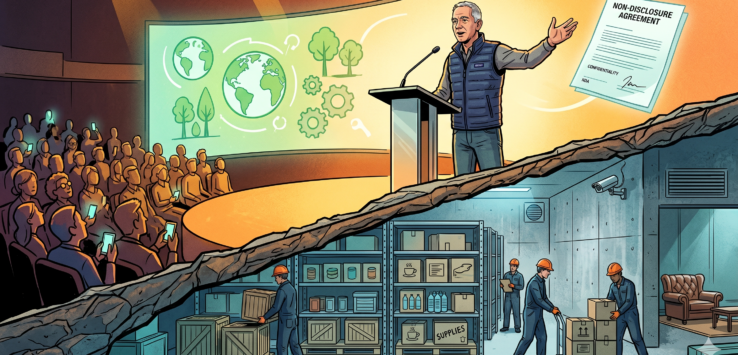
The contractor who poured the concrete couldn’t post about it. That detail, more than anything else, is the one that stays with you.
Not the blast-proof doors. Not the hydroponic farms. Not the escape hatches or the reinforced medical bay or the retractable pool floor. The part that lands is the NDA. The insistence, from people who spend their public lives talking about transparency and open-source everything and democratizing access, that the workers building their private survival infrastructure sign legal documents promising never to describe what they saw underground.
I brought this up on a Wednesday evening in Palo Alto, at the kind of restaurant that requires a reservation three weeks out and serves food in portions that suggest abundance is a vulgarity. With me were Mr. X, a security consultant named Dale who had spent the last two years advising high-net-worth clients on what he carefully called “resilience planning,” and Maya, a climate scientist who had been invited to several of these conversations professionally and had developed a particular expression for them — not quite contempt, not quite despair, something more precise than either.
“Walk me through the client profile,” I said to Dale.
“Founder. Usually post-exit or late-stage. Usually male. Usually in their late thirties to mid-fifties.” He said it the way doctors describe a patient population — clinically, without judgment, as though the specificity made it neutral. “Primary concern used to be civil unrest. Now it’s more diffuse. Climate. AI disruption fallout. Geopolitical instability.” He paused. “A surprising number cite their own industry as a threat vector.”
“They’re afraid of what they built,” said Mr. X.
“They’re hedging against what they built. There’s a distinction.”
“Is there?”
Dale thought about it with the genuine consideration of a man who had asked himself this question before. “Professionally, yes. Personally—” He picked up his drink. “Less clear.”
“Walk me through a standard package,” I said.
“It varies. Entry level is a second passport and a property in a low-risk jurisdiction. New Zealand is popular. Parts of Portugal. Some of the Scandinavian countries for the clients who’ve thought about it more carefully.” He set down his glass. “Mid-tier adds hardened infrastructure. Independent power, water filtration, food production capability, medical supplies for eighteen to twenty-four months. Communications that don’t rely on public internet.” A pause. “Premium is what you’ve been reading about. Full compounds. Staff. Extended capacity. The whole thing.”
“Staff,” said Maya, who had been quiet.
“Security, maintenance, medical. Yes.”
“Who are they staffed with?”
“Professionals. Well-compensated.”
“And when the Event happens—” she used the word the way people use words they find slightly absurd but have given up arguing about — “the staff are in the bunker too?”
Dale’s expression shifted by approximately two millimeters. “That’s a conversation each client has individually.”
“But generally.”
“Generally the arrangements vary.”
“The arrangements vary,” Mr. X repeated, slowly.
“There’s a whole literature on this,” said Maya, with the tone of a scientist who has read the literature and found it clarifying in the wrong direction. “The people who’ve written about it call it the ‘guard problem.’ If civilization collapses, what keeps your security staff loyal? You’ve got the guns, the food, the survival infrastructure — and they’ve got the same guns, the same food, the same survival infrastructure.” She looked at Dale. “The proposed solutions in the literature are — and I’m not editorializing here — paying them enough that their families are taken care of, or building such a comprehensive dependence that loyalty is structural.”
“Both of those are serfdom,” said Mr. X.
“Both of those are serfdom,” she agreed.
Dale had the specific expression of a man whose job required him not to have opinions about the moral architecture of his clients’ contingency plans. “I advise on physical security and logistics. The staffing philosophy is—”
“Someone else’s department,” I said.
“The client’s.”
“Right.”
A waiter materialized, refilled water glasses, dematerialized. The restaurant hummed with the specific frequency of a place where important people came to discuss important things in low voices.
“Here’s the part I can’t get past,” I said. “The same people building these things are the ones on stage at every conference talking about AI as a tool for human flourishing. Democratizing intelligence. Lifting all boats. The whole performance.” I looked around the table. “And then they go home and quietly pour concrete for a facility that will sustain a hundred and twelve people when the boats stop lifting.” I paused. “A hundred and twelve specific people, chosen in advance, while seven billion others work out the math.”
“They’d say the bunker is what allows them to reboot civilization,” Maya said. “I’ve heard this framing. ‘We’re the seed bank.’ ‘Someone has to preserve the knowledge.’ ‘If we don’t survive, who rebuilds?'”
“Who rebuilds,” said Mr. X.
“The implication being that they are, specifically, the ones humanity cannot afford to lose.”
“Which is a remarkable conclusion to reach about yourself,” I said.
“It’s a conclusion that requires a very particular sequence of decisions about your own importance,” Maya said. “And also, incidentally, about everyone else’s expendability.”
Dale had been listening with the patient expression of a man on the wrong side of a conversation he’d agreed to attend. “Look — I understand the critique. I’m not sure it’s entirely fair, but I understand it.” He leaned forward. “These people genuinely believe bad things are coming. Some of them are right. Climate projections, geopolitical instability, the economic disruption from AI — these aren’t paranoid fantasies. And when bad things have come historically, the people with resources survived at higher rates. They’re doing what wealthy people have always done.”
“Which is,” said Mr. X.
“Making sure they’re okay.”
“And calling it civilization preservation.”
Dale picked up his drink. “The framing is convenient, I’ll grant you that.”
Outside, Palo Alto was doing its evening thing — the quiet suburban streets that contained, beneath the surface, an extraordinary concentration of wealth and anxiety and contradictions stacked so carefully they’d achieved a kind of structural integrity. Somewhere to the south, in the hills, someone was almost certainly pouring concrete.
“You know what the tell is?” Maya said, on the way out. She said it in the way she always did — not dramatically, just as an observation that happened to be devastating. “If they actually believed the technology was going to fix things — the AI, the clean energy, the longevity medicine, the whole package — they wouldn’t need the bunkers.” She buttoned her jacket. “The bunker is the honest version of the keynote.”
Outside, Mr. X lit a cigarette he’d been saving.
“You think they know that?” I asked.
“The ones pouring concrete?” He exhaled slowly. “Yeah. I think that’s why the NDAs are so thorough.”