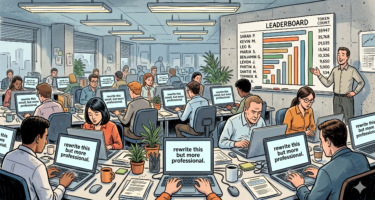
McKinsey currently employs twenty thousand AI agents alongside forty thousand humans. In eighteen months, by their own projection, those numbers will be equal. Their global managing partner announced this in an interview with the Harvard Business Review with the relaxed tone of someone describing a new office coffee machine.
Nobody in the article asked about the forty thousand humans.
I read this to the table on a Thursday evening in San Jose, at a place that used to be a steakhouse and was now a steakhouse with a QR code menu and a tablet where the hostess used to stand. With me were Mr. X, a management consultant named Priya who had recently rebranded her practice as “agentic transformation advisory,” and a laid-off project manager named Tom who was on his second beer and his fourth month of job searching.
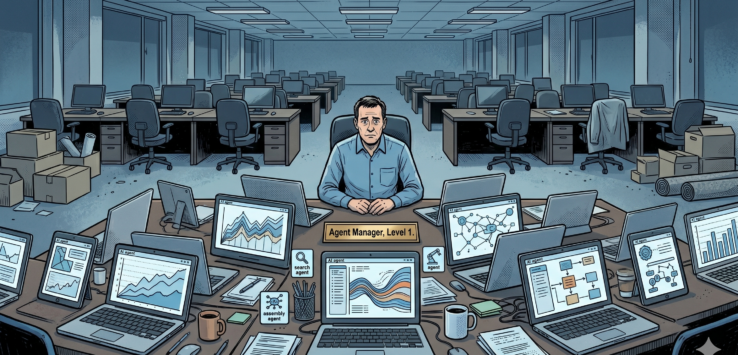
“The new prestige job,” Priya said, with the enthusiasm of someone who had built a deck around this, “is agent manager. You oversee the AI systems. You set the objectives. You evaluate the outputs. You’re the human in the loop.”
“How many humans in the loop per agent?” I asked.
“One manager can oversee dozens of agents simultaneously.”
“So one human job for every fifty that disappeared.”
“It’s not a one-to-one—”
“What’s the ratio?”
Priya did the face of someone whose deck didn’t include this slide. “It depends on the workflow complexity.”
Tom, who had been listening with the patient expression of a man personally acquainted with the ratio, set down his beer. “I managed a team of twelve at Salesforce. Process coordination, stakeholder communication, project delivery. The whole function.” He paused. “They replaced it with an agent suite in Q4. I got a severance package and a Coursera subscription to learn AI skills.” He looked at Priya. “Is agent manager one of the AI skills?”
“It can be,” she said carefully.
“What does it pay?”
“That’s still—”
“More or less than what I was making?”
Priya picked up her drink, which was its own kind of answer.
“Here’s what I find genuinely surreal about this moment,” I said. “Six months ago the pitch was augmentation. AI as a tool. A copilot. The human remains in control, the human remains essential, the human just gets superpowers.” I looked around the table. “Now the pitch is that the most valuable thing a human can do is manage the things that replaced the other humans. We’ve gone from ‘AI works for you’ to ‘you work for the AI pipeline’ in about eighteen months.”
“That’s not inaccurate,” Mr. X said. “Though I’d add that the humans managing the agents are, by all accounts, also being evaluated on whether they could be replaced by a meta-agent that manages the agents.”
“That’s not a thing yet,” Priya said.
“It’s a thing in three papers published this quarter,” said Mr. X. “I read them on the flight down.”
Priya opened her mouth and then did the thing she’d been doing all evening, which was recalibrating in real time against information that was moving faster than her consulting practice.
“The thing nobody says out loud,” Tom said, slowly, in the way of a man assembling a thought he’d been carrying for a while, “is that the agent manager job requires understanding what the agents are actually doing. Which requires knowing how to do the work the agents are doing. Which is the work that got automated.” He looked at the tablet menu on the table, glowing cheerfully, waiting to take an order without any human involvement. “So the prerequisite for the new job is mastery of the old job. But the old job no longer exists to learn in.”
A silence settled that had the weight of something true and unresolved.
“The apprenticeship problem,” I said.
“There’s a name for it?” Tom asked.
“There are several papers about it,” said Mr. X. “Also read on the flight.”
“The industry acknowledges it,” Priya said, in the tone of someone whose industry acknowledges a lot of things it then continues doing. “Stanford’s HAI has new coursework. MIT Sloan introduced modules on managing autonomous systems. There’s a whole—”
“Tom,” I said. “The Coursera subscription.”
“The Coursera subscription,” he agreed.
“What’s on it?”
He took out his phone. “Prompt engineering fundamentals. AI workflow design. Agentic systems overview. Introduction to machine learning for non-technical managers.” He put it away. “Twelve weeks. Self-paced.” He looked at Priya. “Is that enough to become an agent manager?”
“It’s a starting point,” she said, with the gentleness of a doctor delivering a diagnosis that isn’t the diagnosis the patient wanted.
Outside, a delivery robot trundled past the window, carrying something for someone, going somewhere, completely unbothered by any of this. It had no opinions about the labor market. It did not need a Coursera subscription. It would not be rebranding its practice.
“Here’s what keeps me up,” Tom said, not theatrically, just honestly. “It’s not the job loss itself. I’ll figure something out. It’s that the whole thing was framed, for years, as this partnership. Humans and AI, working together, each doing what they do best.” He looked at his beer. “And it turned out what humans do best, in the economic model, is shrink. Get more efficient. Fewer of us, managing more of them, at a cost that makes the spreadsheet work.” He paused. “That’s not a partnership. That’s an org chart.”
Priya, to her credit, didn’t argue with this.
“The org chart hasn’t caught up,” she said instead. Which was what the article about Vercel’s CEO said. Which was what every article about this said. The org chart as a concept doing an enormous amount of work in a conversation that was really about people.
“How long before the org chart catches up?” I asked.
“Eighteen months,” said Mr. X. “That seems to be the number.”
He said it deadpan. It was possible he was joking. It was equally possible he wasn’t. In 2026 the distance between those two things had gotten harder to measure.
The check came via the tablet. No server. No transaction. Clean and efficient and completely fine in every way that was easy to quantify.
Tom picked it up.
“I got it,” he said, which under the circumstances felt like either a gesture or a eulogy and possibly both.