The bar was quiet for a Tuesday. Most of the usual Palo Alto crowd had apparently migrated to Oakland earlier in the week to snag seats in the courthouse gallery — a fact that Mr. X found both amusing and deeply telling about the state of Silicon Valley entertainment.
“You know what the funniest part of all this is?” he said, scrolling through his phone. “Both of these guys genuinely believe they’re saving humanity. One of them just happens to also want to save his equity stake while he’s at it.”
We were at a wine bar off University Avenue — me, Mr. X, and two others. Derek is a managing partner at a mid-size VC fund who famously passed on an early OpenAI round and has been bitter about it in the most financially devastating way possible ever since. Rachel is a corporate attorney whose entire practice is nonprofit governance. She’d been unusually quiet since we sat down, which usually means she’s either disgusted or fascinated. Tonight, apparently, both.
“I have spent fifteen years helping nonprofits stay compliant,” Rachel said, finally setting her glass down. “And I have never — not once — seen a charity end up worth three hundred billion dollars. That’s not mission drift. That’s mission evaporation.”
“To be fair,” I said, “the mission was saving humanity from AI. Hard to put a price on that.”
“OpenAI found a way,” said Mr. X.
Derek had been quiet up to this point, which was unusual for a man who billed $900 an hour for his opinions. “Look, the original deal was clearly different. But let’s not pretend the plaintiff left that board out of the goodness of his heart. He wanted control. He wanted a merger with a certain electric car company. He wanted the thing run like one of his other operations — meaning everyone terrified and on call at two in the morning.”
“So he wanted it run normally,” said Mr. X.
“Exactly,” Derek laughed. “And when they said no, suddenly he’s the patron saint of nonprofit governance.”
Coverage on Rachel’s phone showed Altman stepping out of the courthouse during a recess, looking as composed as a man can look when he’s being accused of grand larceny against the concept of altruism. Earlier in the day, he’d been cross-examined on a text he sent in 2023: “I don’t think OpenAI would have happened without you.” Asked whether he still felt that way, Altman offered: “I have changed my view on Elon significantly.”
“That,” said Mr. X, pointing at the screen, “is the most expensive breakup text in history.”
“It’s almost sweet,” I said. “Two guys start a company to save the world, and now they’re in federal court in Oakland arguing over who loved humanity more.”
“Oakland,” Derek repeated, shaking his head slowly. “They couldn’t even do this in San Francisco. They had to drag their billionaire feelings across the bay.”
Rachel had pulled up a different article — one covering the previous week’s testimony, in which the plaintiff apparently accused opposing counsel of lying, of asking misleading questions, of being part of a conspiracy against truth itself. “He testified like he was posting,” she said. “Altman testified like he was in a job interview. Neither one of them testified like someone who founded a nonprofit because they actually cared about the nonprofit.”
“Altman at least got his story straight,” said Derek. “‘I believe I am an honest and trustworthy business person.’ That’s a sentence no honest and trustworthy business person has ever needed to say out loud.”
“It’s the ‘I’m not a robot’ of courtroom testimony,” said Mr. X.
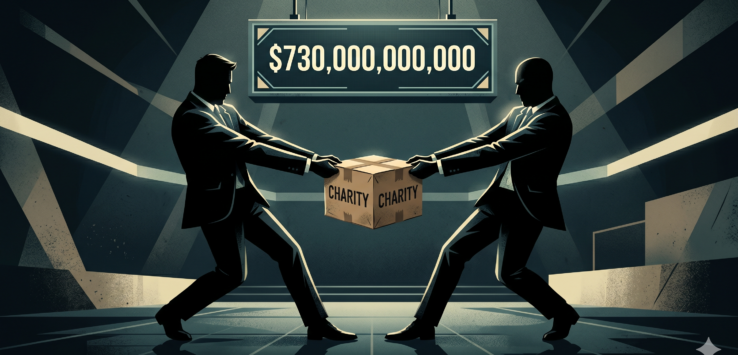
I’d been running numbers on my phone. “The last funding round valued the company at around $730 billion before the money even came in. The plaintiff donated $38 million early on, which he seems to believe entitles him to veto power over the mission in perpetuity. That’s like buying a ticket to Coachella in 2015 and suing because they built a hotel on the grounds.”
“The thing that gets me,” said Rachel, who had clearly been building to something, “is that the nonprofit still technically exists. It still technically owns the for-profit. The charity is still there — it’s just that the charity’s portfolio company is now worth more than the GDP of most countries, and somehow that’s fine. That’s just Tuesday.”
“That’s not a charity,” said Mr. X. “That’s a hedge fund with a mission statement.”
Derek flagged down the bartender. “You know what this trial is really about? It’s not about nonprofit law. It’s not about AI safety. It’s about two extraordinarily wealthy men who are each completely certain that they, specifically, should be in charge of the technology that decides the future of the human race. And they’d like a jury in Oakland to settle it.”
“The jury’s going to go home and ask ChatGPT what to think,” I said.
“And ChatGPT,” said Mr. X, raising his glass, “will carefully decline to comment, citing the ongoing litigation.”
We drank to that.