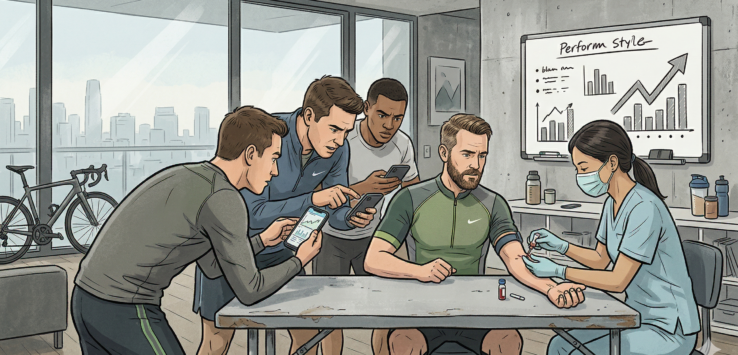
“Seven hundred and forty nanograms per deciliter,” said Brandon, before anyone had ordered drinks.
He said it the way other people say their SAT scores or their net worth — with the specific pride of a number that only impresses people who already know what it means. The table went quiet in the way tables go quiet when someone has opened a conversation that cannot be closed.
Brandon is a 27-year-old founder who has raised $4 million for a defense-adjacent AI company whose exact function he describes differently depending on who’s asking. He had, apparently, spent the previous Saturday morning at something called a T-Party — a gathering in a Marina apartment where men in various states of athletic wear paid between $100 and $400 to have their testosterone levels checked and then discuss the results with other men who had also paid to have their testosterone levels checked.
“And?” asked Mr. X.
“And that’s good. High normal. Above average for my age group.”
“Congratulations,” said Mr. X, in a tone that contained no congratulations.
Also with us was Diane, a people operations executive at a mid-size tech company who had the expression of someone who had sat through a lot of HR trainings and was now watching the source material generate in real time. And Marcus, another founder, early thirties, who had recently taken up jiu-jitsu, cold plunging, and what he described as “ancestral eating,” which appeared to mean he had stopped eating things that came in packaging.
“The thing people don’t understand,” Brandon said, with the evangelical energy of the recently converted, “is that this isn’t about toxic masculinity. It’s about optimization. It’s about peak performance. Zuckerberg gets it. The whole industry is waking up to the fact that we’ve been running ourselves into the ground on cortisol and oat milk.”
“Oat milk causes low testosterone?” I asked.
“It doesn’t help.“
Diane set down her menu. “Can I ask — what specifically are you optimizing for?”
“Focus. Drive. Output. Competitive edge.”
“And you need a blood panel at a house party to achieve that.”
“You need data.“
“You need data to know if you’re masculine enough.”
Brandon pointed at her. “See, that’s the framing I’m pushing back on. This isn’t about being masculine enough. It’s about being the best version of yourself.”
“The best version of yourself that scores above average on a hormone test,” said Mr. X.
Marcus jumped in, the way he always does when he senses the conversation tilting away from his worldview. “Look, the broader point is real. The tech industry spent a decade trying to sand down anything that looked like aggression or competitiveness and called it culture. And then wondered why founders were burning out and products were mediocre.” He leaned forward. “You need a certain energy to build something from nothing. That energy has a biological basis.”
“The biological basis of disruption,” I said.
“I’m being serious.”
“So am I.”
Diane had her professional face on, which is different from her regular face in that it reveals less but contains more. “You know what I find interesting about this whole trend? The industry is currently in the middle of laying off enormous numbers of women — 70% of tech layoffs over the last two cycles skewed female. DEI programs have been quietly wound down. ‘Masculine energy’ is being invoked as a corporate value by at least one major platform CEO.” She paused. “And the framing is that this is all about optimization.”
“It is about optimization,” Brandon said.
“For whom?”
A pause that went on slightly longer than intended.
“I mean — for the company. For output. For—”
“Because from where I’m sitting,” Diane continued, “the output of this particular optimization looks a lot like the industry as it was in 2012, before anyone started paying attention. Which some people found very optimal and others found quite difficult to survive in professionally.”
Marcus made the face of a man who considers himself personally above this critique and therefore not required to engage with it. “Nobody’s saying women shouldn’t be in tech.”
“What is being said?”
“That there’s a place for competitive, driven, aggressive energy in building companies.”
“There always has been,” said Diane. “The question is whether it’s a feature or an excuse.”
The drinks arrived. Brandon checked his phone, probably to look at his testosterone levels again, or possibly to look at whatever app now tracked his testosterone levels in real time, which apparently existed and which he had mentioned earlier in a way suggesting we should all be impressed.
“Here’s what I genuinely don’t understand,” I said. “The same generation that built apps specifically designed to eliminate friction, automate effort, and optimize every possible output — dating, food, transport, sleep — is now going to house parties to manually test their own hormones and eat like it’s 10,000 BC.” I looked at Brandon. “That’s not optimization. That’s cosplay.”
“It’s—”
“You’re a man who raises money from other men to build software, wearing a $300 workout shirt, talking about ancestral eating patterns and testosterone panels.” I paused. “Your ancestors would find this profoundly confusing.”
Marcus laughed despite himself. It was the most human either of them had seemed all evening.
“Look,” Brandon said, with slightly less conviction than he’d started with, “I’m not saying it’s not a bit ridiculous. I’m saying it works. I’m sleeping better. I’m more focused. My numbers are up across the board.”
“Which numbers?” asked Mr. X.
“All of them.”
“Including the $4 million you raised?”
“That was before the T-Party.”
“Then we can’t really attribute it.”
Outside, the Marina glittered with the particular energy of a neighborhood full of people who have decided what they are and are working very hard to perform it convincingly.
On the way out, Diane said, mostly to herself, “You know what’s funny? They spent five years saying masculinity was a social construct. Now they’re spending $400 to measure it.”
“Progress,” said Mr. X.

Leave a Reply