The banner ad at the entrance of the HumanX conference last week read: “Stop Hiring Humans.”
Nobody moved it. Nobody apparently found this ironic enough to mention. Six thousand five hundred investors, founders, and executives walked past it, collected their lanyards, and went inside to discuss the future of human work.
That’s the sentence I led with when I met Mr. X for drinks in SoMa on Wednesday. He let it sit for a moment.
“And the conference was sponsored by the companies doing the not-hiring?” he asked.
“Organized by them,” I said. “Sponsored by them. Keynoted by them.”
“Right.” He picked up his drink. “Anyway, you hear OpenAI bought TBPN?”
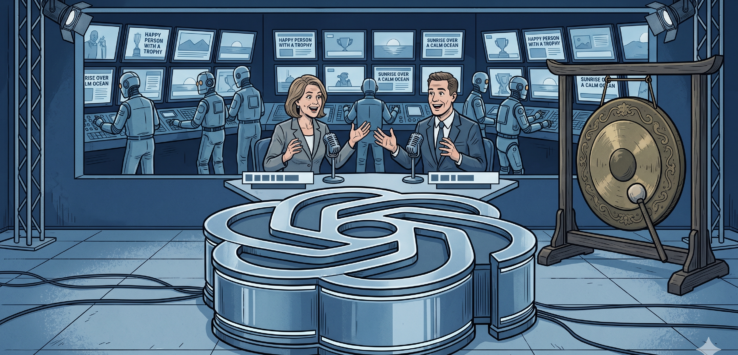
I had. The Technology Business Programming Network — a three-hour daily livestream that had been described, without apparent embarrassment, as SportsCenter for Silicon Valley — had been acquired by OpenAI as part of what the company called its communications strategy. The show was known for its techno-optimism, its interviews with industry power players, and its co-host who introduced each episode from “the TBPN ultradome, the temple of technology, the fortress of finance, the capital of capital.”
Also with us was Renata, a media strategist who had spent fifteen years in journalism before pivoting to communications consulting, which meant she now helped the same companies she used to cover avoid being covered accurately. She had the specific exhaustion of someone who understood exactly what was happening and had decided to be paid well to watch it happen.
“Explain to me why this is different from a company blog,” I said.
“It’s not,” said Renata. “That’s the point. It just has better production value and a gong.”
“They promised editorial independence,” Mr. X said, with the serene expression of a man reading from a document he does not believe.
“They always promise editorial independence,” Renata said. “GE promised editorial independence when they sponsored a TV show in the 1950s. Microsoft promised it with MSNBC. A16z promised it with Future, which lasted about eighteen months before everyone noticed it was a venture capital firm’s Substack with a nicer font.” She swirled her drink. “Editorial independence is what you promise when you’ve just made editorial independence structurally impossible.”
“But TBPN was already—” I started.
“Already a de facto house organ for Silicon Valley optimism, yes,” said Renata. “They weren’t hiding it. The show celebrated funding rounds. They had a gong. The hosts came from startups, not journalism.” She paused. “OpenAI didn’t buy critical coverage and neuter it. They bought cheerleading and gave it a budget.”
“Which is more honest, in a way,” said Mr. X.
“It’s efficient,” said Renata. “Which in Silicon Valley is basically the same thing.”
Outside, a Waymo went past carrying what appeared to be a single passenger having what appeared to be a work call, the physical act of transportation having been fully delegated so that the human cargo could remain productive in transit. Progress, or something shaped like it.
“Here’s what I keep thinking about,” I said. “A few weeks before the acquisition, OpenAI told its staff to cut back on side quests and focus on the core business. They shut down a video app. They paused an erotic chatbot.” I looked at the table. “And then they bought a talk show.”
“The talk show is the core business now,” Renata said. “At a certain scale, narrative control isn’t a side quest. It’s infrastructure.”
“Narrative infrastructure,” said Mr. X.
“It’s been the playbook for a while. Andreessen Horowitz has been running their own media since 2021. Jeff Bezos owns the Washington Post. Marc Benioff owns Time. Elon owns X, which is somehow both the platform and the editorial voice simultaneously.” She ticked them off on her fingers. “At a certain point the question isn’t whether tech companies are buying media. It’s whether there’s any media left that they haven’t bought.”
“There’s still some,” I said.
“For now,” she said, in a way that didn’t invite further optimism.
Mr. X had been quiet in the thoughtful way he gets quiet when he’s assembling an observation. “You know what the most interesting part of this story is? It’s not that OpenAI bought a show that likes them. That’s just sensible spending.” He leaned back. “It’s that they framed it as accelerating ‘the global conversation about AI.’ As if what the global conversation about AI is currently missing is more content from OpenAI.“
“The global conversation about AI does seem to involve quite a lot of OpenAI already,” I said.
“Right. And now they’ve acquired the forum where that conversation happens among the people most likely to influence how the next conversation happens.” He picked up his drink. “It’s vertical integration of the discourse.”
Renata almost smiled. “That’s exactly what it is. And the thing about vertical integration is it’s completely legal, often efficient, and quietly devastating for anyone who isn’t inside it.”
“Like the journalists who used to cover this stuff,” I said.
“Like the journalists who used to cover this stuff,” she agreed. “Most of whom are now working in communications.”
She said this without apparent irony, which was its own kind of irony.
The check came. We argued about it briefly in the way people argue about checks when nobody actually disagrees about who’s paying. Renata got it, expensed it to a client she didn’t name, and said something about the billable hour being the last truly honest unit of value in the information economy.
Outside, I pulled up the TBPN feed on my phone. The co-host was introducing the show from the ultradome, the temple of technology, the fortress of finance. The gong sounded. The ticker ran. An executive from a major AI company was about to share their thoughts on the future of media.
“You going to keep watching?” asked Mr. X.
I put my phone away.
“For now,” I said.

Leave a Reply