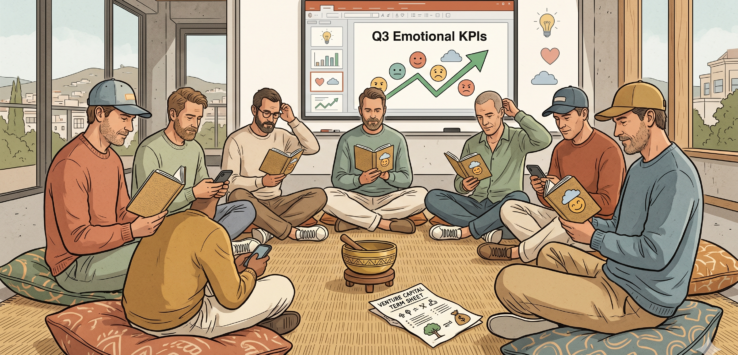
The invitation said Founder Wellness Circle and promised a “somatic reset experience” followed by “authentic peer sharing.” The address was a $4 million townhouse in Los Altos. The dress code, inexplicably, was linen.
I went with Mr. X, who described it on the drive over as “the most interesting thing I’ve been invited to that I genuinely cannot explain.” He wasn’t wrong.
The host was a man named Garrett who had sold a logistics startup in 2023 and spent the subsequent eighteen months, by his own account, “doing the work.” The work, as best I could tell, involved a therapist, a somatic practitioner, a breathwork coach, an executive life designer — which is apparently distinct from a life coach in ways Garrett could explain at length — and something called a “psychedelic integration specialist,” though he was careful to note that this last one was for the ayahuasca he’d done in Peru, which was a legal ceremony, which he mentioned three times.
There were eight of us in total. Founders, investors, one VP of Product who described herself as “currently between identities.” We sat in a circle on very expensive floor cushions. Someone had placed a singing bowl in the center of the room. A diffuser emitted something that smelled like a forest had a meeting with a spa.
“I want to open with an intention,” Garrett said.
Mr. X caught my eye. I looked away.
“For those who don’t know me,” Garrett continued, “I spent eleven years optimizing for outcomes. Revenue. Valuation. Growth metrics. And I got the outcomes.” He paused. “And then I had a panic attack during a board meeting and couldn’t leave my house for two weeks.”
The room nodded with the gravity of people who recognized this story because several of them were living adjacent versions of it.
Also in the circle were Nina, a Series B founder in the HR tech space who had started therapy after her co-founder departure and was now evangelical about it in the way people become evangelical about things that saved their lives; and Curtis, a growth investor who had recently started describing his portfolio reviews as “trauma-informed,” a phrase he used with complete sincerity.
“Can I ask an honest question?” I said, because the silence had reached a length that required filling. “Is this therapy? Or is this a networking event with cushions?”
Garrett smiled the smile of a man who had been asked this before. “It’s community. There’s a distinction.”
“What’s the distinction?”
“Community is peer-to-peer. Therapy is hierarchical. We’re all holding space for each other here.”
“We’re also all investors and founders,” said Mr. X. “Which means at least three people in this room are evaluating whether they’d back the other people in this room, which introduces a dynamic that is the opposite of therapeutic.”
A silence that was more honest than intended.
Nina jumped in. “Okay but that’s exactly the problem, right? That we can’t separate the performance from the person anymore. We’ve been so conditioned to show up optimized that we don’t actually know how to be in a room without pitching something.”
“Including pitching our vulnerability,” said Mr. X.
“That’s — ” Nina stopped. “That’s actually fair.”
Curtis, who had been nodding throughout with the intensity of someone processing his own therapy bills in real time, cleared his throat. “I think what’s being missed is that there’s genuine ROI here. Emotional intelligence directly correlates with leadership performance. Founders who do inner work have lower co-founder conflict, lower team turnover, better decision-making under stress.” He looked around the room. “This isn’t soft. This is edge.”
“You just described therapy as a competitive advantage,” I said.
“It is one.”
“Does it stop being therapy if you’re doing it for the edge?”
Curtis opened his mouth and then, unusually, closed it.
The singing bowl was struck at this point, which I chose to interpret as cosmic timing.
“Here’s what I keep noticing,” I said, because we were apparently doing this, “is that Silicon Valley is extremely good at taking things that are fundamentally human — connection, rest, meaning, grief — and running them through a productization cycle until they come out the other side as a service with a subscription tier and a measurable outcome.” I looked at the diffuser, the cushions, the singing bowl, the linen. “We went from ‘therapy is weak’ to ‘therapy is a productivity hack’ without ever passing through ‘therapy is just a thing humans need.'”
Garrett looked at me with the expression of a man who had also said this in his own therapy, probably for $350 an hour.
“You’re right,” he said quietly. “I still catch myself calculating the ROI of my own emotions.”
“What’s the ROI?” asked Mr. X.
“Better sleep. Clearer thinking. Lower cortisol.”
“So the goal is still optimization.”
“The goal is—” Garrett paused. “I don’t know what the goal is anymore. Which is, apparently, progress.”
The circle continued. People shared things that were real — the loneliness of founder life, the identity collapse that follows an exit, the specific psychological damage of building something for years and then being told by a market it was worth less than expected. It was, genuinely, a room full of humans having a human conversation.
It was also, I kept noticing, a room full of humans who had each paid $200 for the privilege, whose host was developing it into a membership community with a waitlist, and whose “authentic peer sharing” would likely appear, lightly anonymized, in a future newsletter about founder mental health that would be used to market the next cohort.
On the way out, Mr. X stopped to look at the framed print in the hallway. It read, in clean sans-serif type: “What gets measured gets managed.”
“Peter Drucker,” I said.
“In a wellness circle,” said Mr. X.
We stood with it for a moment.
“To be fair,” I said, “it’s better than not measuring anything.”
“Sure,” said Mr. X, stepping out into the Los Altos night. “Everything is better than the thing before it. That’s what we keep saying.”


Leave a Reply