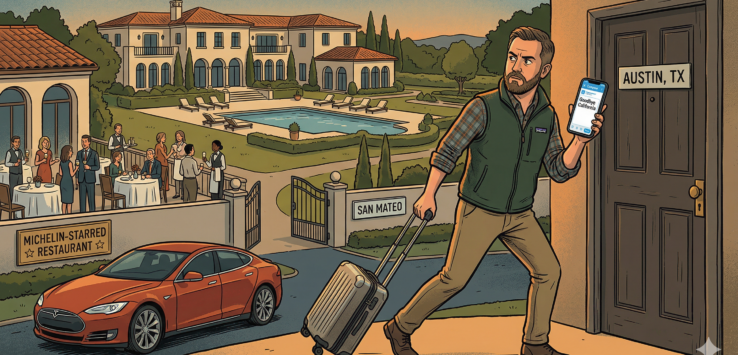
“I’m leaving California.”
Patrick said it the way people announce terminal diagnoses — gravely, with the quiet dignity of a man who has made peace with the inevitable. The table absorbed the news. Nobody looked surprised. Two people nodded slowly. One checked their phone.
“Florida?” asked Mr. X.
“Texas, actually. Austin.”
“Bold,” said Mr. X, in the tone he uses when he means the opposite.
Patrick is a second-time founder, currently pre-revenue but post-term-sheet, worth somewhere between “comfortable” and “life-changing” depending on how his Series B closes. He had been talking about leaving California since 2020. Then since 2021. Then since 2022, when he described San Francisco as “structurally uninhabitable” before signing a two-year lease in Pac Heights. He was back on the subject now because of the proposed California wealth tax — a one-time 5% levy on assets above $1 billion, pushed by a healthcare union to offset federal Medicaid cuts — which had ignited what could conservatively be described as the most expensive group chat panic in the state’s history.
We were at a wine bar in Palo Alto, with Patrick, Mr. X, and Sandra, a tax attorney whose client list had apparently tripled in the past six weeks and who had the specific exhaustion of someone making a lot of money from other people’s hysteria.
“Walk me through the math,” I said.
“It’s simple,” Patrick said. “Once you establish the legal precedent for taxing unrealized gains—”
“You’re not a billionaire,” said Mr. X.
“Not yet.”
“The tax starts at a billion.”
“For now.”
“He’s right that it’s a slippery slope argument,” Sandra said, with the neutrality of a professional who has given this speech many times this month. “The concern is legitimate even if the current proposal doesn’t affect him directly. Though—” she glanced at Patrick — “it really doesn’t affect him directly.”
“It affects the ecosystem,” Patrick said. “Larry Page left. Larry Ellison is out. David Sacks posted ‘message received’ and started packing. When the people at the top of the capital stack leave, the whole thing unravels.”
“David Sacks called San Francisco a cesspool at the Republican National Convention,” I said. “He was already leaving philosophically. The tax just gave him a moving date.”
Patrick made the face he makes when a point lands that he doesn’t want to acknowledge. “Look, the symbolic damage alone—”
“These people have been announcing they’re leaving California since 2020,” Sandra said. “Some of them have left. Most of them kept their companies here, kept their networks here, kept their club memberships here, and got a Nevada mailing address for tax purposes.” She swirled her wine. “Leaving California is a genre. It’s not always a literal event.”
“This time is different,” Patrick said.
“They said that in 2021 also,” said Mr. X. “And 2022. And 2023.”
“The tax proposals weren’t this aggressive before.”
“The proposals that haven’t passed yet.”
“But if they do—”
“If,” said Mr. X.
The wine bar had filled up with the Palo Alto Friday crowd — the quiet, expensive version of tech culture, the kind that drives sensible electric vehicles and argues about school board candidates. Half of them were probably having some version of this conversation. The other half were probably already in Austin.
“Here’s what I find genuinely interesting,” I said. “The same people most loudly threatening to leave are the ones who spent the last two years celebrating the SF comeback. The ‘city is back’ newsletters. The ‘I’m bullish on San Francisco’ posts. The conspicuous brunches in Hayes Valley.” I looked at Patrick. “You were at that dinner in October. The one where everyone talked about how exciting it was to build here again.”
“That was before—”
“It was four months ago.”
Patrick had the decency to look slightly uncomfortable. “Look, I love San Francisco. I genuinely do. That’s what makes this so hard.”
“Is it hard?” asked Mr. X. “Or is it a negotiating tactic?”
Sandra almost smiled. “More than a few of my clients are using it as exactly that. Drafting contingency plans, making noise publicly, hoping the ballot measure softens or fails, at which point they will have successfully avoided a tax by threatening to leave without actually leaving.” She paused. “It’s a very efficient strategy if you have the right advisors.”
“So the exit threat is the product,” I said.
“In some cases, yes.”
Patrick looked like a man whose chess move had just been explained out loud in front of everyone. “That’s not what I’m doing.”
“Of course not,” said Mr. X.
“I’m genuinely evaluating my options.”
“As you have been since 2020.”
A silence in which Patrick refilled his glass, which was a $28 pour that he’d selected without looking at the price, which is its own small argument about how hard California has really made his life.
“You know what the tell is?” Sandra said. “The people most panicked about the wealth tax are mostly panicked about the principle. The idea that California might tax paper wealth at all. The actual dollars, for most of them, are manageable.” She set down her glass. “What they can’t stand is the precedent. The implication that their unrealized billions are a public resource as much as a private one.” She paused. “That’s a philosophical crisis dressed up as a tax problem.”
“Well,” said Patrick, with the quiet dignity of a man who has not yet booked a moving truck, “philosophy is expensive.”
Outside, the Caltrain rumbled through downtown Palo Alto, carrying people who did not have the option of relocating their tax residency to Austin and calling it a principled stand. Nobody at the table mentioned this. It was that kind of evening.
“You actually going to go?” I asked Patrick, on the way out.
He thought about it with more honesty than expected.
“Probably not,” he said. “The ecosystem is still here. The deals are still here.” A pause. “My kids’ school is here.”
“So California wins again.”
“California wins again,” he agreed. “For now.”
He said for now with great conviction, in a tone that suggested he’d be saying it again in 2027.



Leave a Reply