Nobody at the table hNobody at the table had been to space. This felt worth noting, given that two of them had opinions about it with the confident specificity of people who had.
“The delay makes complete sense strategically,” said Will, a defense-adjacent investor who described his portfolio as “hard tech” with the emphasis on hard, as in serious, as in not your uncle’s consumer app fund. “You do the Moon first. You establish the infrastructure. You prove the supply chain. Mars was always a second chapter.”
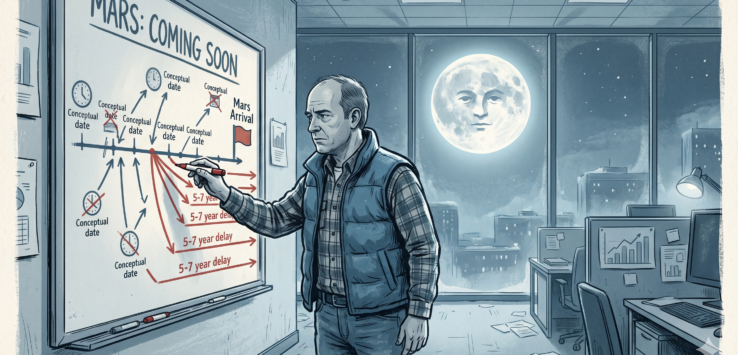
“The second chapter that’s now been delayed five to seven years,” said Mr. X.
“Strategically delayed.”
“Is there a non-strategic delay? When you announce a delay, do you ever say ‘this is chaos, we have no idea what we’re doing?'”
Will looked like a man who had sat through too many board meetings to find this question interesting. “The point is the vision is intact.”
We were at a rooftop bar in Mission Bay — myself, Mr. X, Will, and a science journalist named Priya who had spent the last three years covering the space industry and had developed the specific exhaustion of someone who writes the same headline at two-year intervals with slightly different numbers.
The occasion, loosely, was SpaceX’s announcement in February that it was deprioritizing Mars by five to seven years to focus on lunar missions, which had landed in the tech press with the muted thud of a story everyone had half-expected but nobody wanted to fully process.
“Here’s what I find interesting,” said Priya, with the tone of someone who has found many things interesting and received minimal thanks for it. “The original Mars timeline was a million people by 2050. Then it was a crewed mission by 2026. Then 2028. Now we’re looking at the early 2030s at the absolute earliest, for an uncrewed landing, on a planet that — and I want to be precise here — has gravity too low for human health, radiation levels that would be acutely dangerous, no breathable air, and soil made partially of perchlorates, which are toxic.”
“Which is why you terraform it,” said Will.
“Terraforming Mars would take hundreds of years minimum, by the most optimistic scientific estimates.”
“Technology accelerates.”
“Atmospheric chemistry doesn’t.”
Will waved his hand in the way people wave their hands at obstacles that exist below their altitude of thinking. “You’re doing the thing where you take the current state of technology and project it forward linearly. That’s not how breakthroughs work.”
“It is, however,” said Priya, “how physics works.”
A small silence.
“The delay is actually the part I find most clarifying,” I said. “Because it reveals something about what Mars was always for. It was never really a plan. It was a direction. A narrative. You don’t need Mars to be achievable for Mars to be useful. You need it to be compelling.”
“Compelling to who?” asked Mr. X.
“To investors. To engineers who want to work on interesting problems. To the press. To the public imagination.” I looked at Will. “To people who find it more interesting to fund something pointed at another planet than something pointed at this one.”
“That’s reductive,” Will said.
“Which part.”
He thought about it. “The implication that the vision is cynical.”
“I didn’t say cynical. I said useful. Those are different things.” I picked up my drink. “A vision can be genuinely held and also conveniently structured. Musk probably does want to go to Mars. He also benefits enormously, in contracts and talent and cultural cachet, from being the man who is going to Mars. The vision and the brand are the same thing.”
Priya had been quiet, looking at her notes the way journalists look at their notes when they’re deciding whether to say the thing they actually think. “The book that’s been making the rounds — More Everything Forever — makes the argument that the Mars dream is essentially a form of climate denial. Not the crude kind, but the sophisticated kind. The kind that says: yes, Earth has problems, but the real solution is out there, after we build the AI god and the Mars colony and the space stations.” She closed her notebook. “It lets you feel serious about the future without doing anything about the present.”
“That’s a pretty dark read,” said Will.
“The dirt on Mars is poisonous,” Priya said. “I’m comfortable with dark reads.”
Will ordered another round in the way people order another round when the conversation has arrived somewhere they’d rather leave. “Look. I believe in the mission. I think humanity becoming multiplanetary is genuinely important for long-term species survival.”
“On what timeline?” asked Mr. X.
“Long-term.”
“How long?”
“Hundreds of years. Thousands, maybe.”
“So not a problem you’ll be around to solve.”
“That’s the point of long-termism. You think beyond yourself.”
Mr. X nodded slowly. “And in the meantime, the thinking-beyond-yourself is funded by government contracts, produces useful aerospace technology, generates enormous personal wealth, and requires no immediate accountability for any of the promised outcomes.” He let that land. “Very generous of you.”
Will laughed, which was either a concession or a deflection — with Will it was genuinely hard to tell.
Below us, Mission Bay was doing its new San Francisco thing — gleaming biotech campuses and AI company offices and a waterfront that had been thoughtfully designed for people with the time and money to use it. Somewhere to the south, a SpaceX facility was building rockets pointed at the Moon, which was pointed at Mars, which was pointed at a future that kept moving five to seven years away no matter how fast you drove toward it.
“You know what’s funny,” Priya said, on the way out. “The novel that supposedly inspired all of this — Red Mars — is a story about how colonizing Mars destroys it. About the violence and the politics and the corporate exploitation and the underclass of workers nobody talks about.” She pulled on her jacket. “They all read it as a blueprint.”
“What was it?” I asked.
“A warning,” she said.
Outside, the fog was coming in off the Bay, the way it always does, indifferent to timelines.d been to space. This felt worth noting, given that two of them had opinions about it with the confident specificity of people who had.
“The delay makes complete sense strategically,” said Will, a defense-adjacent investor who described his portfolio as “hard tech” with the emphasis on hard, as in serious, as in not your uncle’s consumer app fund. “You do the Moon first. You establish the infrastructure. You prove the supply chain. Mars was always a second chapter.”
“The second chapter that’s now been delayed five to seven years,” said Mr. X.
“Strategically delayed.”
“Is there a non-strategic delay? When you announce a delay, do you ever say ‘this is chaos, we have no idea what we’re doing?'”
Will looked like a man who had sat through too many board meetings to find this question interesting. “The point is the vision is intact.”
We were at a rooftop bar in Mission Bay — myself, Mr. X, Will, and a science journalist named Priya who had spent the last three years covering the space industry and had developed the specific exhaustion of someone who writes the same headline at two-year intervals with slightly different numbers.
The occasion, loosely, was SpaceX’s announcement in February that it was deprioritizing Mars by five to seven years to focus on lunar missions, which had landed in the tech press with the muted thud of a story everyone had half-expected but nobody wanted to fully process.
“Here’s what I find interesting,” said Priya, with the tone of someone who has found many things interesting and received minimal thanks for it. “The original Mars timeline was a million people by 2050. Then it was a crewed mission by 2026. Then 2028. Now we’re looking at the early 2030s at the absolute earliest, for an uncrewed landing, on a planet that — and I want to be precise here — has gravity too low for human health, radiation levels that would be acutely dangerous, no breathable air, and soil made partially of perchlorates, which are toxic.”
“Which is why you terraform it,” said Will.
“Terraforming Mars would take hundreds of years minimum, by the most optimistic scientific estimates.”
“Technology accelerates.”
“Atmospheric chemistry doesn’t.”
Will waved his hand in the way people wave their hands at obstacles that exist below their altitude of thinking. “You’re doing the thing where you take the current state of technology and project it forward linearly. That’s not how breakthroughs work.”
“It is, however,” said Priya, “how physics works.”
A small silence.
“The delay is actually the part I find most clarifying,” I said. “Because it reveals something about what Mars was always for. It was never really a plan. It was a direction. A narrative. You don’t need Mars to be achievable for Mars to be useful. You need it to be compelling.”
“Compelling to who?” asked Mr. X.
“To investors. To engineers who want to work on interesting problems. To the press. To the public imagination.” I looked at Will. “To people who find it more interesting to fund something pointed at another planet than something pointed at this one.”
“That’s reductive,” Will said.
“Which part.”
He thought about it. “The implication that the vision is cynical.”
“I didn’t say cynical. I said useful. Those are different things.” I picked up my drink. “A vision can be genuinely held and also conveniently structured. Musk probably does want to go to Mars. He also benefits enormously, in contracts and talent and cultural cachet, from being the man who is going to Mars. The vision and the brand are the same thing.”
Priya had been quiet, looking at her notes the way journalists look at their notes when they’re deciding whether to say the thing they actually think. “The book that’s been making the rounds — More Everything Forever — makes the argument that the Mars dream is essentially a form of climate denial. Not the crude kind, but the sophisticated kind. The kind that says: yes, Earth has problems, but the real solution is out there, after we build the AI god and the Mars colony and the space stations.” She closed her notebook. “It lets you feel serious about the future without doing anything about the present.”
“That’s a pretty dark read,” said Will.
“The dirt on Mars is poisonous,” Priya said. “I’m comfortable with dark reads.”
Will ordered another round in the way people order another round when the conversation has arrived somewhere they’d rather leave. “Look. I believe in the mission. I think humanity becoming multiplanetary is genuinely important for long-term species survival.”
“On what timeline?” asked Mr. X.
“Long-term.”
“How long?”
“Hundreds of years. Thousands, maybe.”
“So not a problem you’ll be around to solve.”
“That’s the point of long-termism. You think beyond yourself.”
Mr. X nodded slowly. “And in the meantime, the thinking-beyond-yourself is funded by government contracts, produces useful aerospace technology, generates enormous personal wealth, and requires no immediate accountability for any of the promised outcomes.” He let that land. “Very generous of you.”
Will laughed, which was either a concession or a deflection — with Will it was genuinely hard to tell.
Below us, Mission Bay was doing its new San Francisco thing — gleaming biotech campuses and AI company offices and a waterfront that had been thoughtfully designed for people with the time and money to use it. Somewhere to the south, a SpaceX facility was building rockets pointed at the Moon, which was pointed at Mars, which was pointed at a future that kept moving five to seven years away no matter how fast you drove toward it.
“You know what’s funny,” Priya said, on the way out. “The novel that supposedly inspired all of this — Red Mars — is a story about how colonizing Mars destroys it. About the violence and the politics and the corporate exploitation and the underclass of workers nobody talks about.” She pulled on her jacket. “They all read it as a blueprint.”
“What was it?” I asked.
“A warning,” she said.
Outside, the fog was coming in off the Bay, the way it always does, indifferent to timelines.


Leave a Reply