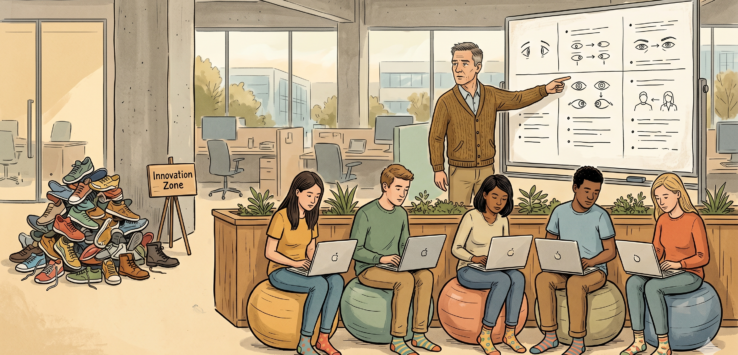
The website was called Noshoes.fun. It tracked, in real time, which Silicon Valley startups had adopted a no-shoes policy in their offices. This was a real thing that existed, that someone had built, and that was being discussed at the dinner table with the gravity usually reserved for Series B term sheets.
“It’s about psychological safety,” said Aaron, who ran a mid-size AI infrastructure company in SoMa and had implemented the policy three months ago. “When people take off their shoes, they’re symbolically leaving the outside world behind. They’re more present. More themselves.”
“They’re also more likely to get a staple in their foot,” said Mr. X.
“We don’t use staplers.”
“That’s probably related.”
We were at dinner in Hayes Valley — myself, Mr. X, Aaron, and Jen, an HR director at a larger tech company who had recently been tasked with what her leadership described as “Gen Z integration strategy,” which in practice meant she spent her days figuring out why twenty-three-year-olds kept quitting after four months and how to make them stop.
She had the specific exhaustion of someone whose job title had become a euphemism for a problem nobody wanted to name directly.
“Walk me through the etiquette classes,” I said, because I had read about this and needed to hear it out loud from someone involved.
Jen set down her fork. “So — and I want to be clear that I personally have complicated feelings about this — several companies, including ours, have started offering etiquette coaching for early-career employees. How to present in meetings. How to communicate with senior stakeholders. How to read a room.”
“How to read a room,” Mr. X repeated.
“It sounds condescending. I know it sounds condescending.”
“Does it also be condescending?”
“Some of it is genuinely useful professional development,” Jen said, with the careful precision of someone constructing a sentence they’ll have to defend to HR. “And some of it is — ” she paused — “an attempt to compress twenty years of informal workplace socialization into a six-week course, because a generation of people had their formative professional years interrupted by a pandemic and then got laid off before they fully figured out how offices worked.”
“And now they’re back in offices they were told they’d never have to return to,” I said.
“Wearing socks,” said Mr. X.
Aaron looked mildly offended. “The no-shoes thing is actually very well-received.”
“By whom?”
“By our employees.”
“The ones who are still there?”
A small silence with a pointed interior.
“Here’s the thing I keep coming back to,” I said. “Gen Z was told, for a solid decade, that tech was the golden path. Six-figure entry-level salaries. Stock options. Ping pong tables. Change the world from a standing desk.” I looked at Jen. “And then AI automated the entry-level jobs, the ping pong tables went away, the return-to-office mandate arrived, and the etiquette coach showed up to explain how to make eye contact with your VP.” I paused. “That’s a significant rebrand.”
“The market changed,” Aaron said.
“For them specifically.”
“For everyone.”
“The proportion of workers aged 21 to 25 at large tech companies has been cut in half in two years,” Jen said quietly, in the tone of someone reciting a statistic they find uncomfortable. “The average age of a tech worker went up five years in the same period. We are actively, structurally removing young people from an industry that spent years recruiting them.” She looked at her wine. “And the advice we’re giving them is to get certified in AI ethics and try LinkedIn.”
“LinkedIn,” said Mr. X.
“I didn’t write the guidance.”
Aaron had been quiet, turning his water glass. He had the look of a man who occupied both sides of this argument simultaneously and was aware of the irony. “Look — I’m not going to pretend the industry hasn’t pulled up the ladder a little. But the economics are real. Why hire a junior engineer at $90k to do something an AI can do in thirty seconds? The math doesn’t work.”
“The math works for the company,” said Jen.
“That’s what math is for.”
“And in ten years, when your senior engineers age out and there’s no mid-level talent pipeline because nobody got to learn from the bottom up?”
Aaron made the face of a man who had been asked this before and had a rehearsed answer that didn’t fully satisfy him. “We’ll cross that bridge.”
“You’ll cross it in your socks,” said Mr. X.
The table was quiet for a moment in the pleasant way tables go quiet when something true and slightly uncomfortable has just been said and the food provides a convenient transition.
“Here’s what I genuinely don’t understand,” I said. “The industry that spent years celebrating disruption — moving fast, breaking things, celebrating the twenty-two-year-old dropout who rewrote the rules — is now sending its entry-level employees to etiquette class and tracking whether they’re wearing shoes.” I looked at Aaron. “You either believe in young people with unconventional energy or you don’t. You can’t do both.”
“We believe in young people with unconventional energy who have also learned to communicate effectively in a professional context,” Aaron said.
“That’s just conventional energy with a branding problem.”
Jen almost laughed. It was the most relaxed she’d seemed all evening.
“You know what the tell is?” she said. “The companies that are loudest about Gen Z being difficult, entitled, hard to retain — they’re almost always the ones who eliminated remote work, cut the benefits, laid off the entry class, and then expressed surprise when nobody wanted to work there anymore.” She picked up her glass. “Turns out if you make the job worse and the path forward less clear and the security nonexistent, people leave. This is not a generational mystery. It is cause and effect.”
“With shoes off,” said Mr. X.
“With shoes off,” she agreed.
Outside, Hayes Valley was doing its early-evening thing — the coffee shops transitioning to wine bars, the sidewalks full of the young and the employed and the recently laid off, sometimes overlapping. A twenty-something walked past in chunky sneakers, headphones on, expression unreadable.
“You think they’re going to be okay?” I asked, mostly to the street.
“The ones who figure out the AI tools will be fine,” Aaron said, with the confidence of a man whose job was not at risk from the AI tools.
“And the rest?”
He shrugged. “They’ll find something.”
“Something,” Jen said, in the tone that word deserves.
On the way out I noticed Aaron had left his shoes at the door of the restaurant, which did not have a no-shoes policy.
I didn’t say anything. Some things you just let be.

Leave a Reply