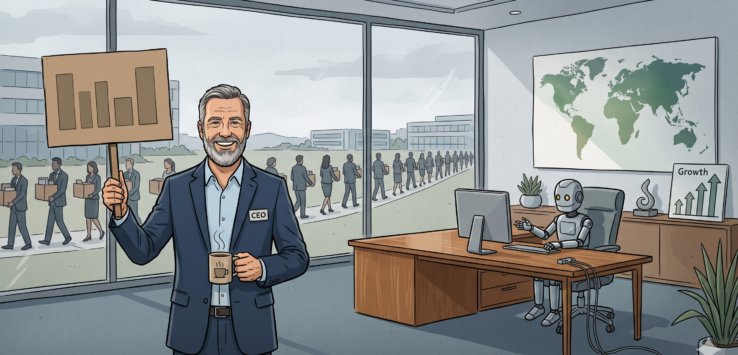
OpenAI allegedly published a policy document last week proposing that the productivity gains from AI should be shared with workers — specifically through a four-day workweek at full pay. The same OpenAI that is building the systems companies are using to justify laying off thousands of workers. The same OpenAI whose conference allegedly featured a banner that read “Stop Hiring Humans.” The same OpenAI that just raised $110 billion and is approaching a trillion-dollar valuation on the back of automating knowledge work.
This is real. I did not make it up.
I read it to Mr. X over the phone on a Tuesday afternoon. There was a long pause.
“So the arsonist is proposing fire safety regulations,” he said.
“That’s one way to put it.”
“What’s the other way?”
I thought about it. “There isn’t really another way.”
We were out that evening at a wine bar in the Mission — myself, Mr. X, a labor economist named Dara who had spent the last two years studying AI’s effect on the workforce and had the specific exhaustion of someone whose worst predictions were becoming quarterly earnings calls, and a product manager named James who worked at a mid-size AI company and had genuinely good intentions about everything, which in Silicon Valley is its own kind of tragedy.
“Walk me through the logic,” I said to James, because he’d been nodding at his phone when I mentioned the OpenAI proposal.
“It’s actually a meaningful policy contribution,” he said. “They’re acknowledging that AI-driven productivity gains shouldn’t just flow to shareholders. They’re proposing wealth funds, tax restructuring, worker benefits—”
“They’re proposing that governments solve the problem their products are creating,” said Dara.
“They’re starting a conversation—”
“About other people fixing the consequences of their business model.” Dara set down her glass with the practiced precision of someone who had made this point in academic papers and was now making it in wine bars, which is less satisfying but more widely read. “The four-day workweek proposal is genuinely interesting as a policy idea. The problem is that OpenAI doesn’t employ most of the people being displaced by OpenAI. The truck driver who loses his route to an autonomous system doesn’t work for Sam Altman. The junior analyst whose entry-level job got automated doesn’t have an OpenAI benefits package.” She paused. “The proposal is for someone else to give those people a shorter week. After OpenAI has already taken their full week.”
James opened his mouth and then reconsidered, which was a form of progress.
“Here’s what I keep thinking about,” I said. “Every major wave of automation in history has come with a version of this promise. The industrial revolution was supposed to free humans from drudgery. Computers were going to eliminate paperwork and give us all more leisure. The internet was going to democratize everything.” I looked around the table. “And each time, the productivity gains went mostly to capital, the disruption went mostly to labor, and the people whose jobs disappeared got a brochure about retraining.” I picked up my drink. “The four-day workweek proposal is a more elegant brochure. But it’s still a brochure.”
“That’s uncharitable,” James said. “They’re genuinely trying to think through second-order effects.”
“They published a thirteen-page document,” said Mr. X. “The second-order effect they should be thinking through is what happens when the workforce realizes the company publishing thoughtful policy papers about worker wellbeing is the same company making the workforce structurally optional.”
“People aren’t stupid,” Dara said. “There’s a reason AI job anxiety is running at historic levels. The workers most at risk know they’re at risk. They don’t need a white paper. They need a job.”
James had the look of a man who agreed with more of this than he was professionally comfortable admitting. “Okay. But what’s the alternative? Not build the technology?”
“That’s always the question that ends these conversations,” said Dara. “And it’s a real question. But it’s also a rhetorical escape hatch. ‘What’s the alternative’ implies the only two options are full-speed-ahead or standing in front of a train. There’s a lot of territory between those.” She leaned forward. “You could slow down. You could build more carefully. You could share equity with the workers whose data trained your models. You could lobby for the policy changes yourself instead of publishing documents suggesting governments should do it.”
“OpenAI does lobby—” James started.
“For its own interests,” said Mr. X. “Which is fine. That’s what companies do. But let’s not confuse lobbying for deregulation and favorable AI policy with lobbying for a four-day workweek for displaced warehouse workers.”
The bar had filled up around us with the Tuesday Mission crowd — the mix of longtime residents and recent arrivals that characterized every San Francisco neighborhood in the middle of its latest transition. Half of them were probably on their phones. A reasonable number were probably using AI tools. Some of them had probably had their hours cut or their roles restructured in the last year.
Nobody looked like they were enjoying a shorter week.
“You know what the tell is?” Dara said, eventually. “The document is thirteen pages about what governments and societies should do differently. There’s one paragraph — I counted — about what OpenAI itself commits to changing.” She finished her wine. “Thirteen pages of advice. One paragraph of accountability. That ratio is not accidental.”
James was quiet for a moment, in the genuine way of someone actually thinking rather than performing thinking. “I don’t disagree with the critique,” he said finally. “I just — I work on this stuff. I actually want it to go well. I want the benefits to be shared. I think the people writing that document believe that too.”
“I think they probably do,” said Dara, not unkindly. “Believing it is the easy part.”
On the way out, I pulled up the OpenAI policy document on my phone and read the four-day workweek paragraph again. It was, as proposals go, genuinely reasonable. Thoughtful, even. The kind of thing that would look good in a congressional testimony and feel good to write and mean something, eventually, for someone, somewhere, under the right conditions, if the right governments acted with sufficient speed and the right companies cooperated voluntarily with the right degree of sincerity.
Outside, a Waymo turned the corner, empty and purposeful, going wherever it was going without anyone to drive it.
“You working tomorrow?” Mr. X asked.
“Five days this week,” I said.
“Same,” said Dara.
James checked his phone. He had a seven AM.
The four-day workweek remained, as it has for some time, a promising idea whose time was always just around the corner.

Leave a Reply