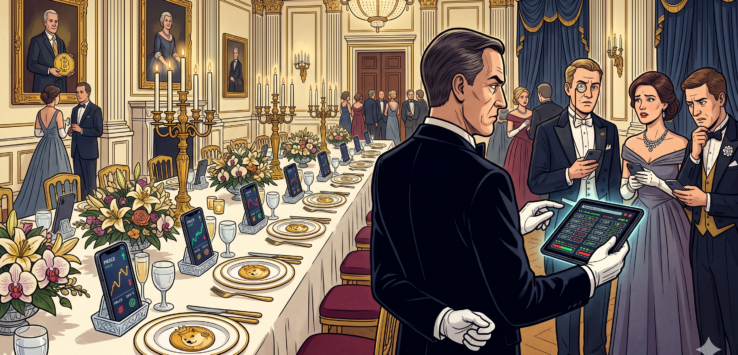
The invitation did not say quid pro quo. It said exclusive dinner with the President of the United States, which in Washington is considered a different thing, although the distinction has been getting harder to locate lately.
The mechanics were straightforward enough, in the way that elaborate things are sometimes straightforward. Buy $TRUMP, the meme coin launched by the President of the United States forty-eight hours before his inauguration. Accumulate enough of it. If you held enough — the top two hundred and twenty wallets would get dinner, the top twenty-five would get a private White House tour — the President would like to have you over.
The coin jumped fifty percent on the announcement.
I read this to the table on a Friday night in SoMa. The table absorbed it in silence the way tables absorb things that are too strange to respond to immediately.
“So,” said Mr. X eventually, “the access is the product.”
“The access was always the product,” said Danny, a crypto fund manager who had the specific exhaustion of someone who had spent years arguing that the industry deserved to be taken seriously and was now watching it be taken seriously in ways he hadn’t anticipated. “We just usually had the decency to run it through a PAC.”
Also with us was Reena, a government ethics attorney who had been described to me as someone who had seen everything and was finding that assessment recently tested. She had arrived with a glass of wine she’d been working on since before we sat down and the expression of a woman mentally updating her priors in real time.
“Walk me through your objection,” Danny said to her, in the tone of a man who knew the objections and had decided to find them interesting rather than concerning.
“Where would you like me to start,” she said. It wasn’t a question.
“Start with the coin.”
“The President of the United States launched a speculative financial instrument tied to his personal brand two days before taking office. His family controls the entity behind it. Foreign nationals can buy it. Foreign governments can buy it. The top holders were offered access to the president contingent on continued holding, which means the price of the coin is now partially a function of how much people want to get near the administration.” She paused. “That’s not a gray area. That’s not even a light gray area. That’s the emoluments clause, the securities laws, and basic conflict of interest doctrine having a collision in public.”
“And yet,” said Mr. X.
“And yet,” she agreed.
“The crypto industry spent two years lobbying for a seat at the table,” I said. “This is technically a seat at the table.”
Danny made the face he makes when something is accurate but inconvenient. “Look — I’m not going to defend the mechanism. The meme coin thing was embarrassing. Even people in the industry said so. Erik Voorhees called it stupid and embarrassing and he’s about as pro-crypto as it gets.” He picked up his drink. “But the underlying policy shift is real. Regulatory clarity, a pro-crypto administration, actual engagement with the industry — that’s been good for the ecosystem.”
“The ecosystem including your fund,” said Mr. X.
“Including my fund, yes. That’s how interests work.”
“So you got the policy and the president got the coin revenue,” said Reena. “Remind me which party is supposed to be against pay-to-play.”
Danny opened his mouth and then, in a move becoming familiar around tables like this one, reconsidered.
“Here’s what I keep thinking about,” I said. “The crypto industry aligned with this administration specifically on the promise of being treated as a legitimate financial sector. Real regulation. Real infrastructure. A seat at the grown-up table.” I looked at Danny. “And what they got, in addition to the regulatory wins, is the President of the United States running a meme coin that a Chinese shell company bought three hundred million dollars of, while his son publicly denies knowing about a wallet launched in his father’s name.” I paused. “That’s not legitimacy. That’s a hostage situation where everyone agreed to be the hostage.”
“We didn’t agree to the meme coin,” Danny said.
“You didn’t object very loudly.”
“We — ” He stopped. “No. We didn’t.”
Reena was looking at something on her phone. “The dinner was last month, apparently. Twenty-five people. Blockchain data suggests some of them paid the equivalent of several million dollars in coin holdings to secure the invitation.” She put her phone down. “There’s a bill in Congress to ban this. It’s called the MEME Act, which is either the most or least dignified piece of legislation in American history depending on your perspective.”
“It won’t pass,” said Mr. X.
“It will not pass,” she agreed.
“Because the people who would vote for it—”
“Are also receiving crypto donations from the people who attend the dinners. Yes.” She finished her wine. “The ouroboros is on the blockchain now. It’s very transparent.”
Outside, a Waymo went past carrying a passenger who was presumably heading somewhere that had nothing to do with any of this, which felt like the right attitude but wasn’t an option everyone had.
“You know what the funniest part is?” Danny said, on the way out. He said it with the specific humor of a man laughing at something he was also inside of. “The whole pitch for crypto — the foundational pitch, going back to the Bitcoin whitepaper — was about removing trust from the equation. You don’t have to trust a bank. You don’t have to trust a government. The math is the guarantee.”
“And now,” said Mr. X.
“And now the math tells you how much you have to pay to get dinner with the government.” He shook his head. “Satoshi is spinning in his grave. Assuming he’s dead. Nobody actually knows.”
Outside, the coin was up twelve percent since the morning. Somewhere, a wallet was getting closer to a White House tour. The math was working exactly as intended, which was the problem.