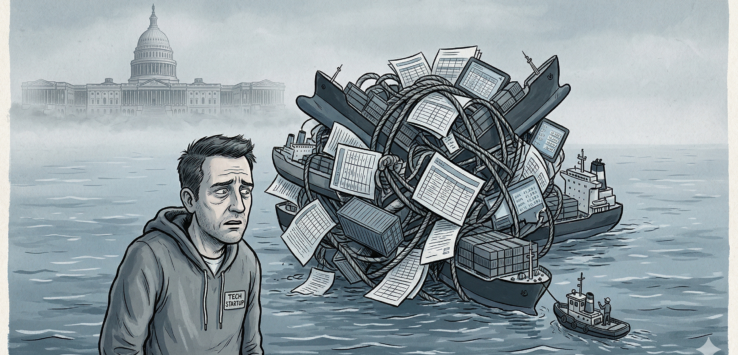
“I just paid $2,400 for a laptop that was $1,600 in January.”
Nobody responded immediately. The number floated over the table the way bad news does — present, undeniable, waiting to be processed.
“In fairness,” said Mr. X, “you expense everything.”
“That’s not the point,” said Daniel, who was a hardware startup founder and had the haunted look of a man who’d spent the last three months watching his bill of materials become a work of fiction. “The point is the supply chain is completely broken and nobody in Washington understands what they’ve actually done.”
We were in a back booth at a dim sum place in the Sunset that Daniel had insisted on because, as he explained, it was one of the few remaining affordable lunch options in San Francisco. Which was either a statement about the tariffs or about San Francisco, or both.
Also with us was Mei, a supply chain consultant who had not slept a full night since February and was operating on a combination of cold brew and vindication, having spent two years warning clients this was coming. And Raj, a policy advisor who worked with several Valley companies on government relations and had the specific exhaustion of someone who’d been on hold with three federal agencies simultaneously for the better part of a quarter.
“Here’s what kills me,” Daniel said, moving a siu mai around his plate without eating it. “Six months ago these same people — investors, founders, the whole ecosystem — were cheering deregulation. Government out of the way. Let the market breathe. Remove the friction.” He looked up. “The friction was apparently the thing keeping our components under $40.”
“The tariffs were not exactly a secret,” Mei said, not unkindly. “I have emails from 2023 flagging this scenario.”
“People thought it was negotiating theater.”
“People thought what was convenient to think.”
Raj had been quiet, arranging his tea things with the precision of a man who’d learned to control small things because large things were currently uncontrollable. “What’s been interesting, professionally, is watching how quickly the politics shifted. Companies that were very publicly aligned with the current administration are now very quietly funding trade association lobbying against the tariff structure.” He paused. “The whiplash is impressive from a purely mechanical standpoint.”
“They thought they were buying deregulation,” said Mr. X. “They got nationalism instead. Different product.”
“Same checkout process,” I said.
Daniel had abandoned the siu mai entirely. “My manufacturer in Shenzhen — we’ve worked together for six years, great relationship, solid quality — they’re now effectively priced out. I’m supposed to reshore. That’s the pitch. Bring it back to America.” He spread his hands. “To where? The infrastructure doesn’t exist. The workforce isn’t trained. The timeline is five to ten years minimum. My Series A runway is eighteen months.”
“The assumption,” Mei said, “was always that supply chains were this abstract, financial, on-paper thing. Numbers in a spreadsheet. And then people discovered they are, in fact, physical. They involve ships and ports and factories and people who spent decades developing specific expertise.” She poured more tea. “You can’t disrupt logistics with a blog post.”
“Someone’s going to try,” said Mr. X.
“Someone already has. It didn’t work.”
I looked around the table. There was something quietly historic about the conversation — the same industry that had spent a decade celebrating disruption, frictionless markets, and moving fast now sitting in a dim sum restaurant carefully discussing the strategic importance of stable international trade relationships.
“Can I say something that might be slightly uncharitable?” I asked.
“Please,” said Raj.
“The tech industry has spent twenty years arguing that government should get out of the way. That regulation was the enemy. That the private sector could solve everything faster and better.” I picked up my tea. “And the first time a government policy directly hits margins — not workers’ rights, not environmental standards, not data privacy — but margins — suddenly everyone has very detailed opinions about the importance of thoughtful policy.”
A silence that was not entirely comfortable.
“That’s not entirely fair,” Daniel said.
“Which part?”
He thought about it with the genuine effort of a person trying to find the unfair part. “We did say government should get out of the way.”
“Of you, specifically.”
“Well—”
“Not of the supply chains you were quietly depending on.”
Mei almost smiled. Raj looked at his tea.
“The honest version,” Mr. X said, “is that nobody in this industry was ever actually against government. They were against government interference in the things that were working for them. And for government support of the things that weren’t.” He signaled for more tea. “Which is just called having preferences.”
The lunch crowd thinned out around us. Daniel eventually ate his siu mai, cold. He had a board meeting at three where he would present three scenarios for the next quarter, all of which he privately described as “bad, worse, and call your investors before they call you.”
On the way out, Raj stopped to read the menu posted in the window. It had a small handwritten note at the bottom: prices subject to change due to import costs.
“At least they’re transparent about it,” he said.
“Everyone’s transparent,” said Mr. X, holding the door, “once they don’t have a choice.”

Leave a Reply