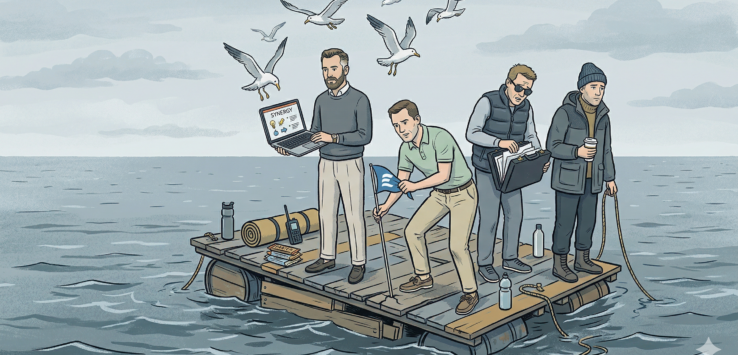
The PowerPoint had forty-three slides. Slide seven was titled “Governance as a Service.” Slide twelve contained the phrase “voluntary social contracts” without apparent irony. Slide thirty-one was just a picture of ocean.
“It’s a seasteading community,” said the man presenting, whose name was Garrett and who had the specific energy of someone who had thought about this for three years and was now physically incapable of not telling you about it. “Sovereign. Self-governing. Opt-in social contract. No legacy bureaucracy, no regulatory capture, no — ” he gestured broadly — “all of this.”
“All of what?” I asked.
He gestured again. “Society.”
We were at a small invite-only gathering in Pacific Heights — the kind of apartment where the art costs more than the building it’s hanging in. Mr. X had brought me along with the warning that it would be “either fascinating or insufferable, possibly both simultaneously.” Also in attendance was Preethi, a constitutional law professor who had been invited, I suspected, to provide an air of academic legitimacy, and who had the expression of someone realizing too late what they’d agreed to.
Garrett advanced to slide eight. “The nation-state is a 17th century technology. We’re running a civilization on legacy infrastructure. Imagine if we were still using Internet Explorer.”
“People still are,” said Mr. X.
“Exactly! And look at the result.”
“I meant that as a counterpoint.”
Garrett smiled the smile of a man whose conviction is structurally immune to counterpoints. “Look, the basic idea is simple. You take a piece of sovereign territory — ocean, land, whatever — you establish a legal framework that’s actually designed for modern humans, you attract the right founding population, and you iterate.”
“You iterate on the country,” said Preethi.
“On the governance model, yes.”
“And if an iteration fails?”
“You roll it back.”
“You roll back the country.”
“The policy.“
Preethi wrote something in her notebook that she did not share with the group.
“What I want to know,” I said, “is who decides what the right founding population looks like.”
Garrett was ready for this one. “It’s self-selecting. People opt in. They agree to the social contract upfront. No coercion.”
“But someone writes the social contract.”
“The founders.”
“Who are—”
“Us, initially. But it evolves.”
“So it’s a country,” said Mr. X, “founded by a small group of wealthy technologists, governed initially by rules they wrote themselves, located somewhere outside the jurisdiction of existing democratic institutions.” He paused. “I’ve read this book before. It doesn’t end with a tech utopia.”
Garrett clicked to slide nine, which was a graph showing declining public trust in governments globally. “Look at the data. People are already opting out. They just don’t have anywhere to opt into yet.”
“They have plenty of places,” said Preethi. “They’re called other countries. People emigrate. They have for centuries. What’s different about this?”
“Those countries have legacy problems too. We’re talking about building from scratch. Clean slate.”
“Clean slates,” Preethi said carefully, “have historically required the removal of whoever was on the slate before.”
A pause. Garrett advanced to slide ten, which was another ocean picture.
“There’s something I find genuinely fascinating about this whole genre of thinking,” I said. “The premise is that the problem with the world is that it wasn’t designed well. That if you just got the smartest people in a room and built civilization from scratch with better UX, everything would work.” I looked around. “But most of the world’s actual problems aren’t design problems. They’re distribution problems. Power problems. Human nature problems. Those don’t get fixed by moving to a barge.”
“Not a barge,” said Garrett. “A modular floating platform.”
“My mistake.”
“The rendering on slide thirty-one is actually—”
“I saw slide thirty-one,” said Mr. X.
Preethi had been quiet for a bit in her particular way. “You know what the tell is? Every one of these projects — seasteading, charter cities, network states — they all use the language of inclusion. Open. Opt-in. For everyone.” She closed her notebook. “But they’re always, always, designed in ways that make them accessible only to people with significant capital. The minimum viable citizen is a high-net-worth individual.”
“Early adopters always have more resources,” Garrett said. “That’s true of every technology.”
“Countries aren’t products.”
“Yet,” said Mr. X, quietly, and it was unclear whether he was joking.
Garrett wrapped up around eleven. He was building a founding team, he said. Looking for people with “nation-building appetite.” There was a sign-up sheet by the door that three people approached and then, upon reflection, did not sign.
In the elevator down, Preethi stared at the floor numbers ticking past.
“You know what’s interesting,” she said, “is that everything they want already exists. Functional government, rule of law, property rights, public infrastructure.” The elevator opened. “It’s called a Scandinavian country. But you can’t be the founder.”
Outside, San Francisco did what it always does — made everything feel simultaneously like the future and a cautionary tale about it.


Leave a Reply