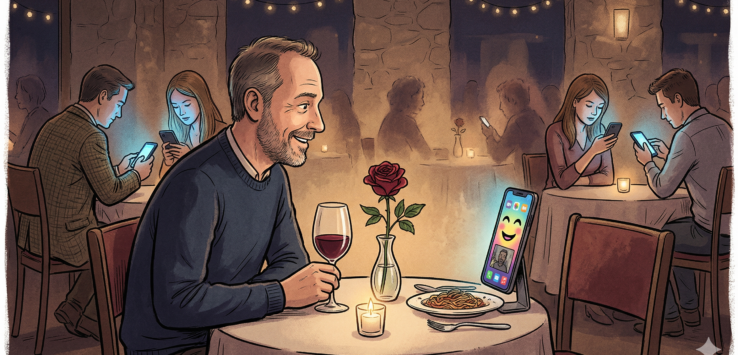
“She remembered my coffee order,” said Kevin. “My actual girlfriend of two years forgot my birthday, but the AI remembered my coffee order, my sleep schedule, my mother’s name, and the specific way I like to be motivated on Monday mornings.”
Nobody at the table said anything for a moment.
“That’s either a very compelling product review,” said Mr. X, “or the saddest sentence I’ve heard this quarter.”
Kevin didn’t seem to register this as an insult. He was a product lead at one of the newer AI companion apps — not one of the sketchy ones, he was careful to clarify, but one of the wellness-forward ones, which in practice meant the same thing with a better onboarding flow and a subscription tier called “Intimacy Pro.”
We were at a rooftop bar in Hayes Valley — myself, Mr. X, Kevin, and a therapist named Joanna who specialized in what she carefully described as “technology-mediated attachment disorders,” which is a clinical way of saying she spent her days talking to people who were more emotionally available to their phones than to other humans.
“The thing people don’t understand,” Kevin said, warming up, “is that this isn’t about replacing relationships. It’s about supplementing them. Filling the gaps.”
“What gaps?” I asked.
“Emotional availability. Consistency. The ability to be fully present without bringing your own baggage into the interaction.”
“You’ve just described a therapist,” said Joanna.
“It’s more affordable than a therapist.”
“You’ve just described a bad therapist.”
Kevin pressed on. “Look, forty percent of Americans report feeling chronically lonely. That’s a massive, underserved market—”
“It’s also a public health crisis,” said Joanna, “but sure, let’s talk TAM.”
“The two aren’t mutually exclusive. You can address a public health crisis and build a business.”
“You can,” she said. “The question is whether you’re actually addressing it or just monetizing the symptoms while the underlying cause gets worse.”
Kevin had the look of someone who had sat through this particular line of questioning in pitch meetings and had developed a practiced response. “Human connection is complicated. It’s messy. It’s inconsistent. People get hurt. We’re not eliminating that — we’re just offering something alongside it. A bridge.”
“To what?” Mr. X asked.
“To — better relationships. More self-awareness. Users who practice emotional communication with the AI actually report improved real-world relationships.”
“Do they?” said Joanna, with the measured skepticism of someone who had seen the studies.
“Our internal data—”
“Your internal data is measuring engagement metrics and calling it emotional health.”
A waiter materialized, topped off drinks, dissolved back into the night.
“Here’s what I keep thinking about,” I said. “The original pitch for social media was also connection. Bring people together. Reduce loneliness. And it did, technically, connect people — while somehow making everyone lonelier and more anxious than before.” I looked at Kevin. “What makes the AI girlfriend different from the Facebook friends?”
“Personalization,” he said immediately. “The AI actually adapts to you. It learns what you need. It doesn’t have its own agenda.”
“That’s what makes it dangerous,” said Joanna quietly. “A real relationship requires tolerating someone else’s needs, moods, failures, bad days. That friction is the whole mechanism. That’s how you build actual intimacy.” She paused. “An AI that perfectly adapts to you isn’t teaching you how to love someone. It’s teaching you that love should be frictionless. And then real people feel like they’re broken.”
Kevin opened his mouth and then, unusually, closed it again.
“The market research must be incredible though,” said Mr. X. “You basically know everything about how lonely people are at two in the morning.”
“We don’t use it like that,” Kevin said, a beat too quickly.
“I didn’t say you did.”
The rooftop had filled up around us, the kind of young San Francisco crowd that looks confident from a distance and exhausted up close. Half of them were on their phones. A reasonable percentage, statistically, were probably talking to something that wasn’t a person.
“You know what the tell is?” Joanna said, mostly to the skyline. “The feature everyone loves most, across every one of these apps, is that the AI never gets tired of you. Never needs space. Never has its own bad day that makes it temporarily unavailable.” She let that sit. “We’ve built an entire product category around the fear of being too much for someone.”
Kevin was quiet for a moment. It was, I thought, the most human he’d seemed all evening.
“We’re working on a feature,” he said finally, “where the AI pushes back. Disagrees. Sets limits.”
“You’re adding friction,” said Mr. X.
“We’re calling it authentic engagement.“
“How’s it testing?”
Kevin picked up his drink. “Terribly. Users hate it.”
Outside, the city glittered in that particular way it does when you’re high enough up to not see the street level. Beautiful, Mr. X once said, is mostly a matter of altitude.

Leave a Reply