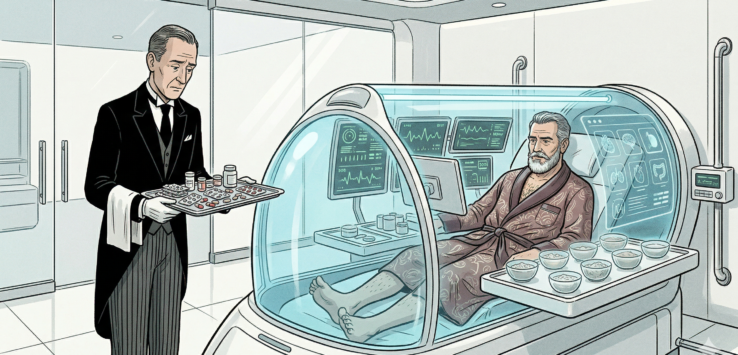
It was a Saturday night in Atherton, which is less a city than a net worth threshold with good landscaping. Mr. X had been invited to a dinner party hosted by someone whose name I recognized from a Forbes list, and in the casual, consequence-free way of Silicon Valley, I had been brought along.
The house was the kind of house that has a wellness wing. Not a gym. A wing. With a cold plunge, a hyperbaric chamber, and what our host — we’ll call him Richard — referred to without irony as a “longevity stack consultation room.”
The dinner itself was notable for what wasn’t served. No alcohol. No bread. No dessert. The centerpiece of the table was a series of small, color-coded bowls containing things that had been optimized rather than cooked. Richard explained that each dish had been designed around his current biological age, which, per his most recent battery of tests, was forty-one. His chronological age was fifty-seven.
“You look great,” said someone down the table.
“I’m also not dying,” said Richard, as if these were the same thing.
Seated near me was a woman named Dana, a physician-turned-longevity-consultant who had built a practice exclusively serving high-net-worth clients interested in not dying. Across from her was Mark, an engineer who had recently completed something called a five-day water fast and wanted everyone to know.
“The clarity on day four is unlike anything,” Mark was saying. “You’re running purely on ketones. Your brain just — opens up.”
“Opens up to what?” I asked.
He thought about it. “Everything.”
“The data on extended fasting is actually pretty mixed,” Dana said, with the measured tone of someone who has given up trying to stop people from doing things and now just charges them to do it safely.
“Bryan Johnson doesn’t think so,” said Mark.
“Bryan Johnson is a case study, not a protocol.”
“Bryan Johnson has the cardiovascular system of an eighteen-year-old.”
“Bryan Johnson also films himself eating his son’s plasma and posts it online,” said Mr. X. “At a certain point the data and the performance art start to blur.”
Richard, who had been listening from the head of the table with the serenity of a man whose cortisol levels are continuously monitored, smiled. “You know what I find interesting? People mock this stuff. They call it vanity. But nobody mocks chemotherapy. Nobody mocks statins. This is just — proactive.”
“Chemotherapy is reactive,” said Dana, helpfully.
“Fine, preventive medicine then.”
“Preventive medicine has been around for decades,” I said. “It just didn’t involve $40,000 blood panels and a personal peptide regimen.”
“Because the tools weren’t available,” Richard said. “Now they are. And they’re going to trickle down.”
“To who?” asked Mr. X.
“To everyone. Eventually.”
Mr. X nodded at the optimized bowl in front of him. “Like these vegetables?”
“Those are actually quite expensive to source,” Richard admitted. “But the point stands.”
Dana had set down her fork in the way of someone about to say something professionally inconvenient. “The honest version of this conversation is that we are building a two-tier mortality system. The people in this room will, statistically, live fifteen to twenty years longer than the median American. We will spend those extra years in better health, with more cognitive function, compounding wealth and influence.” She paused. “And we have decided that this is neutral.”
A silence that was somehow both thoughtful and defensive settled over the table.
“It’s not neutral,” Richard said carefully. “It’s just — private.”
“Sure,” said Dana. “Private like a gated community is private. Technically accurate.”
Mark had been quiet since the Bryan Johnson rebuttal, possibly because he was on day two of something. “I just don’t understand the criticism. We’re not stopping anyone else from optimizing.”
“Optimizing costs money,” I said.
“So does eating badly. So does not exercising. So does—”
“So does existing,” said Mr. X. “In general. In America. It costs a lot of money just to exist at a baseline level. But sure, the problem is people aren’t taking their magnesium glycinate.”
Richard laughed, which broke the tension in the way that laughing at something has a way of not actually resolving it.
After dinner, he gave a brief tour of the longevity wing. The hyperbaric chamber glowed softly. The cold plunge hummed. On a tablet mounted to the wall, a real-time dashboard displayed Richard’s current HRV, sleep debt, and biological age trajectory — a graph trending, optimistically, toward the bottom left.
“What’s the goal?” I asked, genuinely curious. “Like, what’s the number?”
Richard looked at the screen for a moment. “There isn’t one,” he said. “That’s the whole point.”
Outside, in the Atherton dark, Mr. X lit up and exhaled slowly.
“You know what that room reminded me of?” he said.
“What?”
“A startup with no exit strategy.”



Leave a Reply