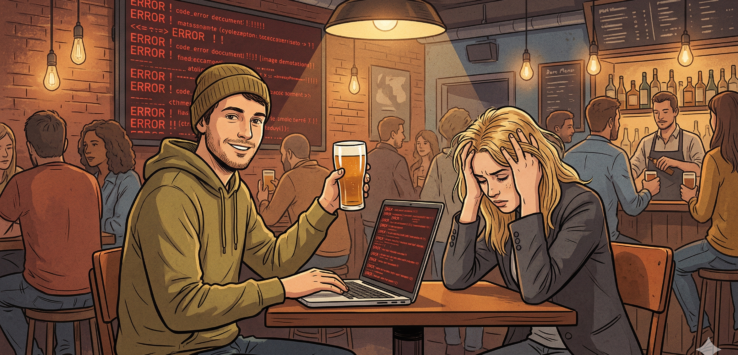
The most funded engineer in the room hadn’t written a line of code in his life. He was twenty-four, had raised $2.3 million, and described his entire development process as “vibing it into existence.” The scary part wasn’t that he believed it. The scary part was that he wasn’t wrong.
His name was Ryan. I’d met him through the startup circuit, at one of those SoMa bars that used to be a warehouse and now charges $18 for a mezcal sour and has exposed brick that may or may not be decorative. With us was Cass, a senior software engineer with eleven years of experience who had been laid off twice in eighteen months and was on her second whiskey when I arrived. And Mr. X, who was watching the whole thing with the quiet amusement of a man attending a very slow car crash.
Ryan was explaining his process.
“I just describe what I want,” he said. “In plain English. And the AI builds it. I don’t touch the code at all, really. I just — vibe it into existence.”
“Vibe it,” Cass repeated.
“That’s actually what people are calling it. Vibe coding.”
“I know what it’s called.”
“It’s kind of incredible when you think about it. The barrier to building has basically dropped to zero. Anyone with an idea can now—”
“Ship broken software at scale,” Cass said.
Ryan smiled in the patient way of someone who has been told his idea won’t work and has decided to find it charming. “I mean, all software has bugs.”
“There’s a difference between bugs and not understanding what your own product does.”
“I understand what it does. I just don’t understand how it does it.”
“That distinction,” Cass said, “is going to matter a great deal when something goes wrong.”
“That’s what AI is for.”
She looked at her whiskey. The whiskey had nothing to offer.
“Here’s the thing I don’t get,” I said. “Six months ago these same companies were doing five-round technical interviews. Leetcode problems. System design marathons. Three weeks to get rejected by a recruiter who couldn’t explain the role.” I nodded toward Ryan. “Now the benchmark is whether you can type a coherent sentence into a chat box.”
“The interview process was always theater,” said Mr. X. “Now the engineering is theater too. It’s consistent, at least.”
“It’s not theater,” Ryan said, slightly less confidently. “My product has real users.”
“How many?” asked Cass.
“Growing fast.”
“That’s not a number.”
“It’s a trajectory.”
Cass set down her glass. She had the energy of someone who had spent a decade learning a craft and was now watching it be Napster’d in real time. “You want to know what I find darkly funny about all this? The same VCs who funded companies to automate factory workers and call center reps and truck drivers — who told everyone that was just progress — are now funding companies built by people who automated the engineers.” She paused. “And somehow the engineers are supposed to find that inspiring.”
“You could learn to use the tools,” Ryan offered, helpfully.
“I use the tools. The tools are good. The tools are also why I got laid off.”
A brief, honest silence.
“The pitch I keep hearing,” Mr. X said, “is that AI handles the tedious parts, freeing engineers to focus on higher-level thinking. Creative problem solving. Architecture.” He looked at Ryan. “But you’re not doing higher-level thinking. You’re not doing any thinking about the code at all. You’re doing prompting and praying.”
“I prefer iterative natural language development.“
“I’m sure you do.”
Ryan’s phone buzzed. He glanced at it and his face did something complicated. “Hm.”
“What?” I asked.
“My authentication system apparently logged out all my users. All of them. Simultaneously.”
“All of them,” Cass said.
“It’s fine. I’ll just ask Claude to—”
“To fix the code you don’t understand, that it wrote.”
“It’ll take like five minutes.”
Cass watched him start typing into his phone with the expression of a surgeon watching someone perform an operation with a butter knife. “The thing is,” she said quietly, mostly to herself, “it probably will take five minutes. That’s the actual nightmare. Not that it won’t work. That it will. Right up until the moment it catastrophically doesn’t, and there’s nobody in the building who knows why.”
Ryan fixed the authentication issue in four minutes. He seemed genuinely delighted. The users were back. The system was stable, or at least stable-adjacent, which in 2026 is close enough for a seed round.
“You know what you remind me of?” Mr. X said to Ryan as we settled the tab.
“What?”
“Those guys in the early 2000s who were buying domain names and calling themselves internet entrepreneurs.”
Ryan looked uncertain whether this was a compliment.
“Some of those guys made a lot of money,” Mr. X added.
“See—”
“And some of them very famously did not.” He stood up, collected his jacket. “The problem with vibing something into existence is that existence has a way of requiring maintenance.”
Outside, the SoMa night smelled like fog and ambition and a faint trace of someone’s Series A burning quietly in the distance.
“You going to be okay?” I asked Cass.
She shrugged. “I’m consulting now. Mostly getting hired to fix the things the AI broke.” A dry smile. “Turns out that market is booming.”

Leave a Reply