It was a Friday night in San Francisco, which these days has the specific energy of a city that can’t decide if it’s having a renaissance or a going-out-of-business sale.
I was out with Mr. X and a rotating cast of the usual suspects. This week’s additions were Tyler, a product manager at an AI startup whose entire personality is having been at OpenAI “before it got big,” and Simone, a bioethicist who had made the questionable life choice of moving to Silicon Valley to study it up close, like a researcher who voluntarily moves into the volcano.
The conversation started, as so many do lately, with Sam Altman.
“Okay, but explain it to me like I’m a normal person,” I said.
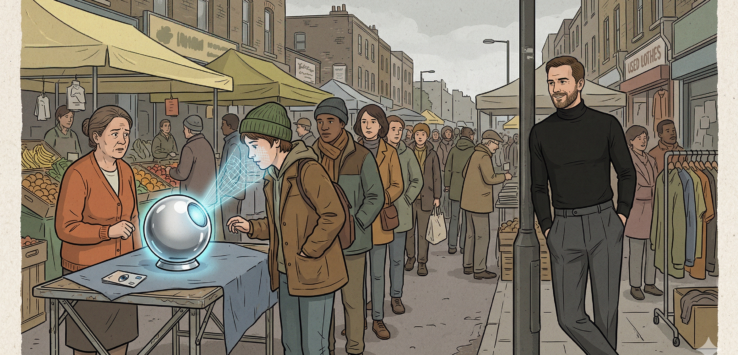
Tyler looked pained. He always looked pained when asked to explain things to normal people. “It’s simple. You go to a physical orb — they’re in like a hundred countries now — it scans your iris, verifies you’re a human being, and in return you get World ID. Proof of personhood. And some crypto. And eventually, maybe, a universal basic income.”
“So you sell your eyeball,” said Mr. X.
“You don’t sell it. It scans it. Biometrically. To confirm your humanity.”
“To a private company,” said Simone.
“To a nonprofit-adjacent entity focused on—”
“Tyler.”
“—the equitable distribution of—”
“Tyler.”
He stopped. “Yes?”
“A billionaire built a machine that travels the world collecting poor people’s biometric data and gives them cryptocurrency in return,” Simone said. “I need you to hear that sentence.”
“When you frame it like that—”
“How would you frame it?”
Tyler thought for a moment. “As a primitive solution to the verification problem created by AI-generated content, which simultaneously pilots a scalable UBI distribution mechanism for the coming post-labor economy.”
Simone stared at him.
“He practiced that,” said Mr. X.
“The thing that gets me,” I said, “is that the orbs are literally called Orbs. They didn’t even try to name it something reassuring. They just went with the most dystopian possible industrial design and leaned in.”
“The orbs are actually pretty elegant,” said Tyler.
“Sure,” said Mr. X. “Very sleek. Very we have always been at war with Eastasia.“
Tyler was undeterred. This is a quality that serves you well in Silicon Valley and essentially nowhere else. “You know what the alternative is? AI floods the internet with fake humans. You can’t tell who’s real. Society breaks down. At least World ID gives you a verified, privacy-preserving—”
“It’s not privacy-preserving,” Simone said. “They have your iris data.”
“They have a hash of your iris data.”
“I’m sure that distinction will be very comforting when it leaks.”
A comfortable silence. Somewhere outside, a Waymo drove itself through a red light, and nobody was surprised.
“Here’s what I keep thinking about,” I said. “The people most likely to scan their eyeballs for $50 in crypto are the people who need $50. And the people building the orb empire are the people who broke the economy that made $50 meaningful in the first place.”
“That’s a bit of a stretch,” Tyler said.
“Is it? OpenAI is literally the company most responsible for the automation wave that’s eating entry-level jobs. And the solution being offered is: give us your biometrics, and we’ll consider giving you a small amount of money. Eventually. Pending regulatory approval.”
“You’re describing every government welfare program ever,” Tyler said, with the confidence of someone who has never needed one.
Simone had gone quiet in the particular way she went quiet when she was deciding how many of her actual thoughts to release into the wild. “You know what the most Silicon Valley thing about this whole project is? The genuine belief that the problem of human poverty is essentially a logistics problem. That it’s unsolved not because of politics or power or history, but because nobody had built the right infrastructure yet.” She paused. “And that the right infrastructure involves an orb.”
“The orb,” Mr. X repeated, raising his glass. “To the orb.”
Nobody else raised their glasses. Then Tyler did, slowly.
“To the orb,” he said, a little sadly.
Outside, the city did what it always does — hummed along, indifferent and expensive, full of people solving problems and creating the ones they’d solve next.

Leave a Reply