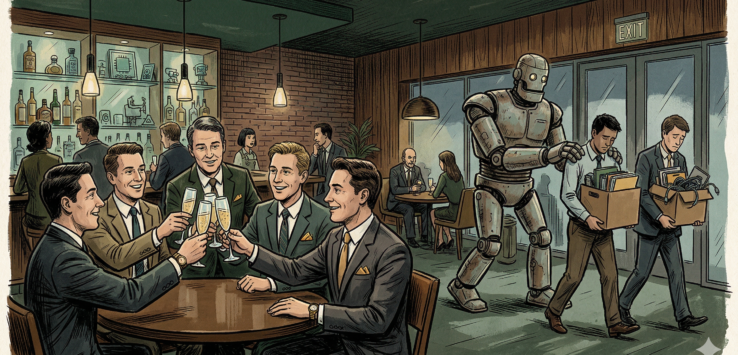
It was a Tuesday night in Palo Alto — which, if you know anything about Palo Alto, means it was indistinguishable from every other night in Palo Alto. Same Tesla-lined parking lot. Same $22 cocktails. Same ambient hum of people casually discussing the end of civilization between bites of wagyu sliders.
I was out with Mr. X and a small crew at one of those places where the lighting is somehow both too dim and too expensive. With us was Marcus — a senior director of “People Strategy” at a mid-sized AI company whose name you’d recognize — and Claire, a former Google engineer who’d been laid off in the third round of cuts and pivoted, as one does, into executive coaching.
“You see the OpenAI news?” Marcus asked, barely looking up from his phone. He said it the way people say you see the game last night — casually, as if the restructuring of human cognitive labor was a sports score.
“Which one?” I said.
“Exactly,” said Mr. X, grinning.
The conversation had started, as most conversations in Silicon Valley do, with someone explaining why everything happening right now is actually incredible. Marcus had spent the better part of twenty minutes walking us through why AGI — Artificial General Intelligence, for the uninitiated — was maybe eighteen months away, give or take a couple of paradigm shifts.
“So what happens to the people whose jobs it eats?” Claire asked. She had a particular talent for asking obvious questions in ways that made everyone uncomfortable.
“They evolve,” Marcus said, without irony.
“Into what, exactly?”
“Prompt engineers. AI oversight roles. The human-in-the-loop stuff.” He waved his hand in a manner that suggested the details were someone else’s department. “Look, we had a whole internal town hall about this. Very transparent. Very empathetic.”
“And then you laid off four hundred people,” Claire said.
“Three-eighty,” Marcus corrected. “And those were performance-related.“
Mr. X nodded slowly, the way he does when he’s pretending to agree before he doesn’t. “You know what I find interesting? Every company that lays people off says it’s performance-related. Yet somehow the performance issues always seem to peak right after a Wall Street earnings call.”
Marcus shifted. “I mean, there’s always going to be some correlation—”
“And now everyone has to come back to the office,” I added, “so management can keep an eye on the employees they haven’t gotten rid of yet.“
“Return-to-office is about culture,” Marcus said, with the conviction of a man who drives forty-five minutes to work and bills it as a spiritual practice. “You can’t build AGI on Slack threads. There’s something irreplaceable about physical collaboration.”
“There is,” said Claire. “It’s called making sure people feel too visible to update their LinkedIn.”
A comfortable silence settled over the table.
“You know what’s wild,” I said, mostly to keep things moving, “is that six months ago every one of these companies was talking about AI as this force for democratization. Giving people superpowers, eliminating drudgery, empowering the workforce.” I paused. “Now the workforce is the drudgery being eliminated.”
“That’s reductive,” Marcus said.
“Which part?”
He thought about it longer than you’d expect. “Look — I’m not going to pretend it isn’t messy. But we’re in the middle of a genuine technological revolution. You can’t stop it. You can only decide whether you want to be on the right side of it.”
“And the right side happens to be the side with the most GPUs,” said Mr. X.
Marcus laughed despite himself. “I mean… yes? That’s how it works.”
Claire had been quiet for a bit, turning her glass. “You know what nobody says out loud? That the people building these systems genuinely believe they’re going to be fine. That the disruption is always going to land on someone else’s job category. A truck driver. A radiologist. A customer service rep.” She looked at Marcus. “Nobody in that town hall was worried about their job.”
“Well, no,” Marcus said. “Because we’re building the thing.”
“For now,” said Mr. X.
The check came. Marcus, to his credit, grabbed it — the universal Silicon Valley gesture that signals the conversation has gone somewhere nobody intended.
As we stood up to leave, he turned to Claire. “Hey, for real though — if you’re looking for your next thing, we’re actually hiring for an AI Transition Consultant role. It’s new. Basically helping organizations manage the human side of automation.”
Claire stared at him for a moment. “You want me to help companies lay people off more smoothly.”
“I’d frame it as—”
“I’ll think about it,” she said. She wouldn’t.
Outside, the Palo Alto night was perfect and climate-controlled, as always. Mr. X lit a cigarette he’d been saving since San Francisco.
“You think he knows?” I asked.
“That the machine’s coming for him too?” Mr. X exhaled slowly. “Oh, he knows. He just figures he’s got maybe two, three good years before it does.” He paused. “In Silicon Valley, that’s basically retirement planning.”

Leave a Reply